

Every placement season, thousands of engineering graduates compete for high-paying technology roles. Yet many struggle to clear technical interviews despite having a degree, completing coding courses, and listing multiple technologies on their resumes.
The gap often lies between understanding technical concepts and applying them effectively during coding assessments, problem-solving exercises, and technical interviews. For engineering colleges, the challenge is equally significant: ensuring students can translate academic knowledge into demonstrable, industry-relevant skills.
This is where 10+ LPA placement preparation becomes important. Students need a structured approach to developing algorithmic thinking, engineering depth, practical project experience, and interview readiness. At the same time, colleges need effective ways to build these competencies, identify skill gaps, and track student progress.
A salary package of ₹10 LPA or above is not determined by a single skill or assessment score. Hiring expectations vary by company, technology role, experience requirements, and recruitment process.
So, what makes students placement-ready for 10+ LPA technology roles, and how can engineering colleges bridge the gap between academic learning and industry expectations?
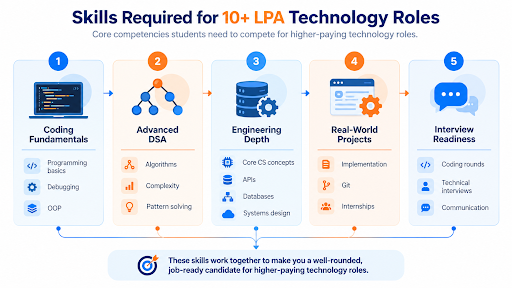
Higher-paying technology roles often involve rigorous evaluations of data structures, algorithms, computational complexity, core computer science concepts, and practical software development capabilities. However, the requirements vary by employer, job family, and experience level.
For example, a software development role may emphasize DSA, problem-solving, and coding proficiency, while a cloud engineering position may place greater importance on networking, cloud infrastructure, automation, and troubleshooting.
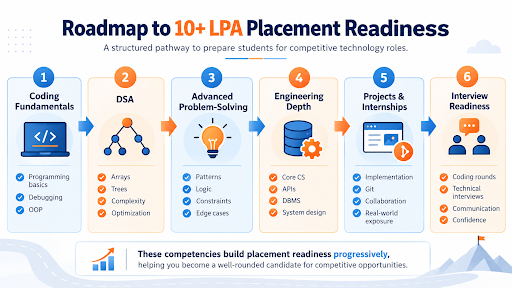
A structured preparation framework connects these competencies through the following progression:
Coding Fundamentals → Strong DSA → Advanced Problem-Solving → Engineering Depth → Projects and Internships → Interview Readiness
Each stage develops a different dimension of technical competence.
Therefore, 10+ LPA placement preparation should be mapped to the competency requirements of target roles rather than treated as a generic coding curriculum.
Programming fundamentals lay the foundation for algorithm development, debugging, and software implementation. Students who lack conceptual clarity often struggle with tasks requiring multiple logical steps, unfamiliar approaches, or complex problem-solving.
The focus should include:
For instance, solving a coding problem for a standard input is only the first step. A technically prepared candidate should also consider boundary conditions, validate the output, identify potential errors, and explain the underlying logic.
Students can strengthen these foundations through structured programming and DSA training, progressing from basic coding exercises to increasingly complex algorithmic challenges.
The objective is not simply to learn programming syntax but to develop the confidence to write, debug, and improve code independently.
Data Structures and Algorithms (DSA) are important in many software engineering assessments because they help recruiters evaluate how candidates approach problems, select suitable data structures, analyze constraints, and optimize computational performance.
Students should develop proficiency in:
However, DSA preparation should go beyond memorizing solutions.
Students need to understand why a particular approach works, when it is appropriate, and how to adapt it to unfamiliar problems.
For example, recognizing when a hash map can improve lookup efficiency or when dynamic programming can eliminate repeated computation demonstrates stronger algorithmic reasoning than simply recalling a previously solved problem.
Resources such as the Google Tech Dev Guide’s Data Structures and Algorithms learning materials can supplement structured coding practice.
Consistent problem-solving, solution analysis, and feedback-driven improvement are more valuable than focusing only on the number of problems completed.
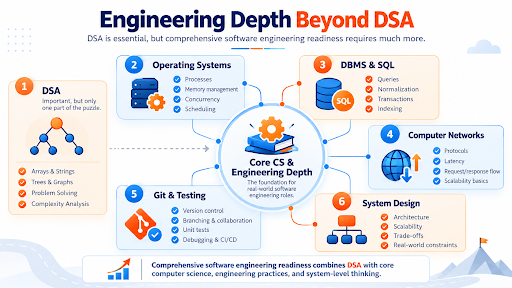
Algorithmic proficiency alone does not establish comprehensive software engineering competence.
Students must also understand how software applications function, how data is managed, how components communicate, and how engineering decisions affect reliability, performance, and maintainability.
Key competency areas include:
Students should also develop awareness of modern development practices, including responsible use of AI-assisted coding tools. AI-generated code still requires human understanding, validation, testing, and security review.
Candidates preparing for product-company and Global Capability Centre (GCC) roles may encounter assessments requiring deeper algorithmic reasoning, engineering fundamentals, or system-level understanding, depending on the position.
Therefore, engineering placement preparation should combine strong core computer science knowledge with role-specific technical depth rather than treating every technology as equally important.
Projects translate conceptual knowledge into demonstrable engineering capabilities.
They also allow interviewers to assess implementation decisions, debugging approaches, architectural understanding, and technical ownership.
Students should focus on:
A project becomes more credible when students can explain its architecture, justify technology choices, discuss implementation challenges, and identify possible improvements.
For example, a student who develops a full-stack application should be able to explain how the frontend communicates with the backend, how data is stored, how APIs are secured, and how errors are handled.
Students can practise development and collaboration workflows through GitHub Skills, which provides interactive courses covering GitHub fundamentals, repositories, pull requests, and collaborative development.
Internship experience can add another layer of practical exposure by introducing students to code reviews, issue tracking, team collaboration, deadlines, and engineering workflows.
However, the value of an internship depends on the actual work performed and the student’s contribution.
The objective is to demonstrate applied engineering capability, not simply accumulate projects, certificates, or internship titles.
Technical interview preparation should reflect the evaluation methods used by target employers.
A candidate may perform well in an online coding assessment but struggle to explain design decisions, analyze complexity, debug an unfamiliar problem, or justify an implementation approach during a technical discussion.
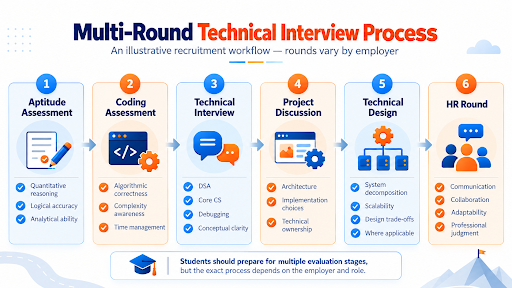
Different recruitment stages evaluate different competencies.
| Recruitment Stage | Competencies Evaluated |
| Aptitude Assessment | Quantitative reasoning, analytical ability, and logical accuracy |
| Coding Assessment | Algorithmic correctness, complexity analysis, and time management |
| Technical Interview | DSA, core computer science, debugging, and conceptual clarity |
| Project Discussion | Architecture, implementation decisions, and technical ownership |
| Technical Design | System decomposition, scalability, and design trade-offs, where applicable |
| Behavioural or HR Round | Communication, collaboration, adaptability, and professional judgment |
Not every recruitment process includes all these stages. Requirements vary by company, role, and hiring process.
Students should therefore research employer-specific expectations, practise relevant assessments, participate in mock interviews, and review feedback regularly.
Technical interview readiness also involves explaining the reasoning behind a solution, discussing alternative approaches, and responding confidently to follow-up questions.
Developing placement readiness across an engineering cohort requires more than isolated workshops or last-minute interview preparation.
Colleges need a structured training model that maps technical competencies to placement goals, evaluates student progress, identifies skill gaps, and directs learners toward relevant improvement activities.
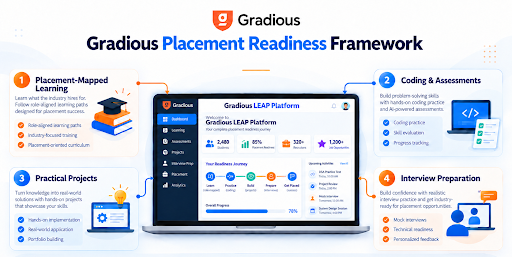
Gradious supports this approach through industry-aligned training programs for engineering colleges and its LEAP learning and evaluation platform.
Placement-Mapped Learning
Gradious offers training pathways aligned with different placement objectives, including service companies, product companies, high-paying technology roles, and GCC opportunities.
These programs focus on relevant competencies such as programming fundamentals, advanced DSA, problem-solving, core technologies, and interview preparation.
This approach helps colleges align training content with the technical expectations of different recruitment pathways.
Continuous Coding and Assessments
Structured coding practice and periodic assessments help evaluate programming proficiency, algorithmic problem-solving, and topic-level competency gaps.
Assessment results can guide targeted revision, additional practice, and improvement activities instead of relying only on overall course completion.
Projects, Internships, and Practical Exposure
Hands-on learning helps students apply technical concepts through practical implementations and industry-relevant projects.
Relevant industry exposure can also strengthen students’ understanding of architecture, debugging, implementation decisions, collaborative workflows, and technical ownership.
Interview and Placement Readiness
Coding evaluations, mock interviews, and structured placement preparation help students practise technical screening and improve their ability to communicate solutions.
The Gradious LEAP platform helps institutions organize learning, coding practice, assignments, assessments, evaluations, and student progress tracking within an integrated environment.
The objective is to develop measurable, role-relevant capabilities that support placement readiness. Participation in training does not, by itself, guarantee a particular salary package or placement outcome.
Students preparing for competitive technology roles should evaluate their readiness through demonstrable competencies rather than course completion or certifications alone.
The following checklist provides a practical self-assessment framework.
| Competency | Evidence of Readiness |
| Programming | Writes correct, maintainable code and handles edge cases |
| DSA | Selects appropriate data structures, designs algorithms, and analyzes complexity |
| Core Computer Science | Explains foundational concepts and applies them to technical scenarios |
| Engineering Practices | Understands testing, debugging, version control, and maintainability |
| Projects | Demonstrates working applications and justifies implementation decisions |
| Internships | Explains technical contributions and development workflows, where applicable |
| Assessments | Performs consistently in relevant timed coding and aptitude tests |
| Interviews | Communicates reasoning and responds effectively to technical follow-up questions |
| Technical Design | Explains appropriate architecture and trade-offs for the target role |
This is a self-assessment framework, not a universal recruitment benchmark.
A student may demonstrate strong competence in one area while still needing improvement in another. Similarly, different employers may prioritize different combinations of technical and professional skills.
The checklist can help students identify competency gaps, prioritize preparation, and track improvement over time.
Engineering colleges can strengthen placement readiness by integrating competency development into the academic calendar rather than concentrating preparation in the final semester.
A structured institutional approach should include:
Colleges should also evaluate more than coding scores.
The National Association of Colleges and Employers (NACE) Career Readiness Competencies framework identifies communication, critical thinking, teamwork, professionalism, and technology among the important dimensions of workplace readiness.
These competencies reinforce the need for a balanced approach that combines technical knowledge, problem-solving, collaboration, and professional skills.
For institutions targeting competitive technology placements, the objective should be to build a measurable development pathway that connects academic learning with role-specific technical preparation.
Such an approach can help colleges identify students who require additional support, recognize those demonstrating strong readiness, and align training more closely with recruitment expectations.
Competitive technology placements demand more than familiarity with programming languages or a strong academic record.
They require algorithmic reasoning, engineering depth, practical implementation skills, and the ability to demonstrate technical competence under evaluation conditions.
For students, the priority is to build these capabilities through structured practice, meaningful projects, continuous assessments, and feedback-driven improvement.
For engineering colleges, the priority is to make that development measurable, role-aligned, and consistent across the student cohort.
Preparing students for 10+ LPA technology roles is not about promising a salary package. It is about developing the competencies that make students competitive for relevant opportunities.
Gradious supports colleges in building this foundation through industry-aligned technical training, coding practice, assessments, practical learning, and placement preparation.
Want to strengthen placement readiness across your engineering cohort?
Explore Gradious’ industry-aligned training programs for colleges and build a structured pathway toward competitive technology roles.