
High attrition, rising salaries, and an ever-widening skills gap, these are the realities IT leaders are battling right now. Important projects stall because tech teams lack expertise in AI, cloud, cybersecurity, and data science. Recruitment pipelines are drying up, and even when new hires are secured, onboarding delays and inflated costs erode ROI.
The challenge is pretty clear: hiring alone cannot solve the talent shortage. The pace of digital transformation is simply too fast, and external talent too scarce, to rely on recruitment as the primary strategy. This is where upskilling your tech teams becomes the smartest business move. By investing in IT workforce training and employee skill development, companies can bridge the gap internally, reduce dependency on external hires, and build a future-ready workforce that drives innovation.
Let us take a closer look at what upskilling truly means for tech teams and how it differs from traditional hiring or reskilling.
Basically, upskilling refers to enhancing the existing skills of employees so they can meet evolving business and technology needs. Unlike hiring, which brings in new talent from outside, upskilling focuses on empowering your current workforce to stay competitive, agile, and aligned with the organizational goals.
However, it is very important to distinguish upskilling from reskilling. Reskilling involves training employees to take on entirely new roles, often in different domains. Upskilling, on the other hand, is about deepening expertise in current roles or expanding into adjacent areas.
For instance, a backend developer learning full-stack development is upskilling, while a project manager transitioning into data analytics is reskilling. Both are valuable, but upskilling is often the faster, more cost-effective way to fix immediate skill gaps.
As the technology is evolving rapidly, the skills that were innovative three years ago may already be outdated today. Upskilling ensures that employees don’t just keep pace with change, but actively drive it. Through continuous learning, they become more versatile, confident, and capable of tackling complex challenges.
Most of the leading IT companies implement structured and industry-aligned training programs that focus on practical and real-world skills to build high-performing engineering teams. Some of the most valuable upskilling tracks include:
Data Structures & Algorithms (DSA):
This course strengthens technical problem-solving, improves code efficiency, and enhances architectural thinking that is critical for any engineering role.
Full Stack Development:
This program covers frontend frameworks, backend APIs, database design, and DevOps basics, enabling engineers to build quality driven scalable applications.
Data Science & Machine Learning:
This training equips IT teams with the ability to extract insights from data, build predictive models, automate workflows, and support AI-driven business initiatives.
Agentforce Programs:
This program is specifically designed for modern AI-enabled enterprise development, helping teams to build intelligent automation, workflows, and digital agents.
Cloud, DevOps & Infrastructure Automation:
This course includes Kubernetes, Docker, CI/CD pipelines, infrastructure as code, and cloud architecture. These skills are essential for building scalable and reliable systems.
These tailored and structured programs create a workforce that is not only technically proficient but also strategically aligned with business goals.
Now that we have defined what upskilling means, let us move on to why it is such a powerful business strategy and how it delivers measurable benefits.
Upskilling is more than a training initiative; it is a strategic investment that delivers measurable business impact. By prioritizing IT workforce training and employee skill development, companies can strengthen their skill set, reduce costs, and improve capabilities.
Cost-Effective Alternative to Hiring
Most importantly hiring new employees is expensive and often inefficient. Recruitment fees, onboarding processes, and salary premiums for niche skills can drain budgets quickly. In many cases, companies spend months searching for the right candidate and face project delivery delays.
In contrast, training programs are extremely cost-effective. They enable software companies to maximize the potential of their existing workforce. Upskilling reduces dependency on external hires, improves ROI, and accelerates project readiness. Instead of paying high salaries for scarce talent, companies can invest in structured training programs that deliver immediate value.
Boost Employee Retention and Satisfaction
Today’s employees demand more than simply a paycheck; they want possibilities for advancement. When organizations invest in employee skill development, they send a clear message: “We value your future.” This fosters loyalty, engagement, and a sense of belonging.
As a result, the companies that prioritize tech talent retention through upskilling often report higher employee satisfaction and positive workplace culture.
Create a Future-Ready Workforce
Emerging technologies like AI, automation, and blockchain are reshaping the IT landscape. Without continuous learning, teams risk falling behind. Upskilling ensures that your workforce is prepared for these shifts, equipping them with digital transformation skills that align with evolving business needs.
Consequently, a future-ready workforce doesn’t just adapt; it leads. Employees trained in cutting-edge technologies can anticipate industry changes, innovate faster, and align their expertise with long-term organizational goals.
Improve Project Delivery and Innovation
Upskilled teams are more agile, collaborative, and productive. They can deliver projects faster, with fewer errors, and adapt to changing requirements with confidence. Upskilling also encourages cross-functional collaboration, as employees gain broader skill sets that allow them to contribute beyond their core roles.
For example, companies like Google and Infosys have demonstrated how structured upskilling programs fuel innovation pipelines. By investing in the workforce, they have created cultures of continuous improvement where employees actively drive new ideas and solutions. This proves that investment in workforce development directly translates to business growth, improved project outcomes, and sustained innovation.
Clearly, the benefits of upskilling extend far beyond cost savings; they touch every aspect of workforce performance and business sustainability.
To address the growing talent challenges in IT, Gradious offers specialized corporate upskilling and reskilling programs that are designed to meet the evolving needs of enterprises. Unlike generic training courses, these programs are built around real-world industry requirements, ensuring that employees gain practical and job-ready skills.
Gradious training programs maximize impact and deliver measurable business results by combining hands-on projects, expert mentorship, and tailored learning paths.
Data Structures and Algorithms (DSA) Program
The Data Structures & Algorithms (DSA) training program enables engineers to solve complex problems faster and write optimized code via algorithmic thinking and coding efficiency. This program is particularly valuable for teams working on scalable applications, where performance and efficiency directly affect customer experience.
Full Stack Developer Program
Modern enterprises need developers who can handle end-to-end application development. The Full Stack Developer Program covers frontend, backend, and deployment, giving participants complete mastery over application building. As a result, the companies can reduce dependency on multiple specialists and accelerate project delivery timelines.
Data Science Engineer (DSE) Program
The Data Science Engineer Program equips teams with advanced analytics, machine learning, and AI-driven insights. By learning how to extract actionable intelligence from data, employees help organizations make smarter decisions, improve customer experiences, and unlock new revenue streams.
Agentforce Training
Automation is no longer optional; it is essential. The Agentforce Training prepares teams to deploy intelligent automation and AI agents that streamline workflows, reduce manual effort, and improve efficiency. This program is especially relevant for enterprises embracing digital transformation at scale.
Infrastructure/DevOps Training
The Infrastructure Bootcamp equips professionals with cloud computing, DevOps, and system reliability skills. With this training, teams can build secure, scalable infrastructures that support business growth while minimizing downtime.
Gradious training programs go beyond theory to deliver tangible benefits:
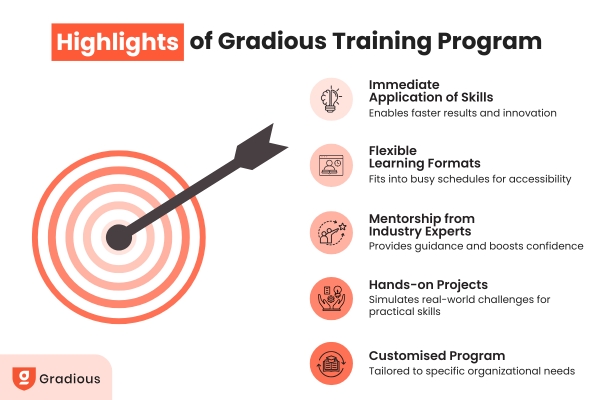
Customized program: Every enterprise has unique challenges. Gradious offers custom corporate training programs tailored to specific organizational needs.
Hands-on projects: Employees get to work on simulations of real-world challenges to ensure that their abilities are immediately applicable.
Mentorship from industry experts: Experienced professionals provide guidance that speeds learning and boosts confidence.
Flexible learning formats: Bootcamps are designed to fit into busy schedules, making them accessible to working professionals.
Immediate application of skills: Participants can apply new knowledge directly to ongoing projects, driving faster results and innovation.
Next, let us explore how enterprises can implement an effective upskilling strategy to maximize these benefits.
Upskilling is most effective when it follows a structured and targeted approach. Many organizations fail because they treat training as a one-off initiative rather than a long-term investment.
Assess Your Workforce Current Skills
Start by understanding where your team stands now. Conduct a comprehensive skills audit to identify strengths, weaknesses, and gaps in your workforce. This assessment should cover both technical expertise (e.g., coding, cloud infrastructure, cybersecurity) and soft skills (e.g., collaboration, problem-solving).
Without this baseline, training programs risk being generic and misaligned with business needs.
Identify Future Technology Needs
Map your upcoming projects, industry trends, and emerging technologies to determine which skills will be most valuable in the next 2–5 years. For example, if your roadmap includes AI-driven products, your team will need digital transformation skills in machine learning and data science. If cloud migration is a priority, DevOps and infrastructure expertise become critical.
This step ensures that upskilling aligns with long-term business strategy rather than short-term fixes.
Partner with a Training Provider
Gradious is a trusted training partner that offers tailored corporate upskilling and reskilling training programs that are designed around enterprise challenges. Unlike off-the-shelf courses, Gradious training programs combine real-world projects, mentorship, and flexible formats to ensure employees can apply new skills immediately.
Measure Outcomes
Track performance improvements, project delivery speed, and employee satisfaction to evaluate ROI. Metrics such as reduced turnover, faster deployment cycles, and improved innovation pipelines provide tangible proof of impact.
Finally, the smartest business decision is to invest in your existing employees rather than employing new ones. Upskilling your tech team ensures sustainability, innovation, and long-term ROI. Companies that cultivate a future-ready workforce via organized training may save money, retain top personnel, and remain ahead in the digital transformation race. Gradious empowers IT enterprises to achieve this with practical, impactful programs that deliver measurable results.