
Currently, the Train and Deploy Model for Employers & traditional hiring model can no longer keep up with modern business demands. Job roles evolve rapidly, and technologies shift overnight, yet truly job-ready talent remains in short supply. Therefore, employers are caught in a loop of longer hiring cycles, rising recruitment costs, and extended onboarding, with no guaranteed productivity outcomes.
This is where the “Train and Deploy Model for Employers” changes the equation. Instead of chasing “ready-made” talent in the competitive market, organizations proactively build the exact skills their business demands. Talent is purposefully trained and deployed directly into live environments, ready to contribute from day one. As a result, employers gain faster productivity, better workforce alignment, and a more scalable talent pipeline.
The global workforce is undergoing a fundamental shift. Here are some of the major converging factors that are forcing employers to rethink how they hire and build talent.
As a result, many companies are now turning to software skill training B2B models that prioritize capability building over credential chasing. These models focus on preparing talent specifically for organizational needs rather than relying solely on the external talent market.
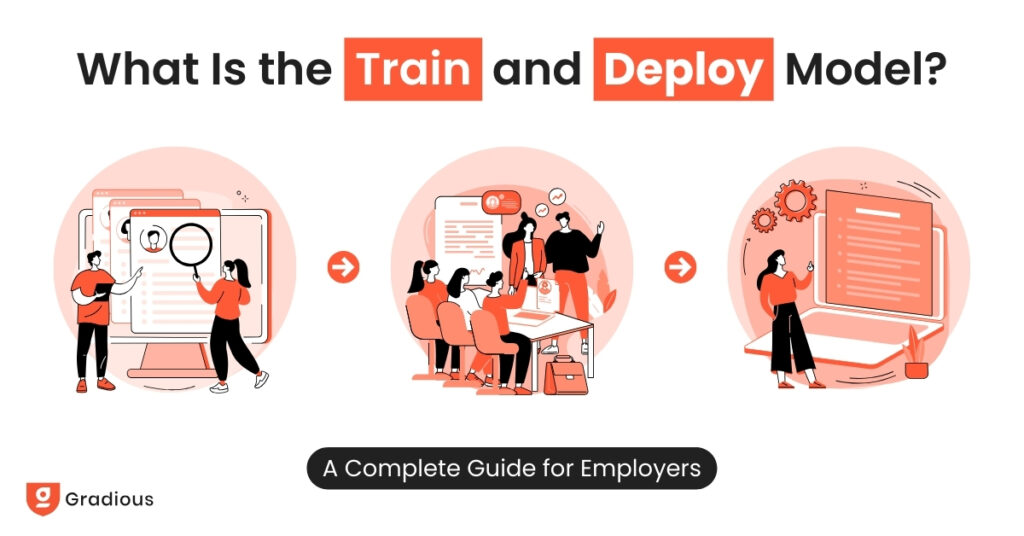
The Train and Deploy model is a modern workforce strategy where talent is first trained on role-specific, job-aligned skills and then deployed into live business environments once they are ready to perform.
Unlike traditional recruitment, this approach builds required skills before deployment. Employers collaborate with training partners to design curriculum aligned with actual job requirements, ensuring that talent is productive from day one.
What truly sets the Train and Deploy model apart from traditional hiring is its shift in focus:
Consequently, employers gain predictable talent outcomes, reduced hiring risk, and faster time-to-value.
Despite its growing adoption, several misconceptions still revolve around “Train and Deploy” approach.
1) One common myth is that “it’s only for freshers.” In reality, Train and Deploy works just as effectively for early-career professionals, mid-level talent, and employees undergoing reskilling or role transitions.
2) Another misconception is that “training delays productivity.” On the contrary, structured training enhances productivity by reducing on-the-job trial and error.
3) Also, many assume that “Train and Deploy is more expensive than hiring experienced talent.” However, when recruitment fees, prolonged onboarding, higher attrition, and delayed productivity are taken into account, Train and Deploy often delivers a stronger return on investment.
Firstly, employers start by identifying the business-critical skills required for both current and upcoming projects to ensure that the training efforts are grounded in real demand.
This process involves:
By doing so, organizations ensure that training investments are directly tied to measurable business needs rather than generic skill development.
After clearly defining skill requirements, candidates will undergo structured software training.
This phase emphasizes:
Therefore, participants gain applied knowledge rather than theoretical knowledge. This significantly reduces post-deployment learning curves and builds confidence before entering live environments.
Following successful training, candidates are deployed directly into live projects or business roles where they can immediately contribute.
At this stage:
Since the training stimulates real-world working conditions, deployment feels like a seamless transition rather than a high-risk handoff. Employers benefit from faster results, while employees gain confidence through meaningful and hands-on contribution.
Here is a quick comparison of why many employers are shifting toward skill-first hiring strategies over traditional talent sourcing.
| Factors | Train and Deploy | Traditional Hiring |
| Productivity | Faster and predictable | Extended onboarding cycles |
| Cost structure | Optimized and scalable | High and often unpredictable |
| Skill relevance | Directly job-aligned | Dependent on market availability |
| Talent scalability | Highly scalable | Limited by talent supply |
| Retention | Stronger engagement and stability | Higher attrition risk |
Here are the key strategic advantages of adopting Train and Deploy model:
Gradious partners with employers to design and execute Train and Deploy programs that are deeply aligned with real-world business needs. Rather than treating training as a standalone activity, Gradious integrates skill development directly into workforce planning. This ensures that talent is truly equipped to perform, not just certified.
The approach is built around four core principles:
Employer-centric program design
Each initiative begins with a detailed understanding of role expectations, project requirements, and technology stacks. We ensure that our training curriculum is tailored to actual business scenarios.
Industry-aligned instructors and mentors
Our mentors bring practical and hands-on experience into the learning process. Their real-world perspective helps bridge the gap between theory and application.
Job-ready skill validation
Candidates are assessed via practical assignments, role-based evaluations, and performance benchmarks that mirror workplace expectations. This structured validation ensures only job-ready talent moves forward to deployment.
Seamless deployment support
We enable a smooth transition from training environments to live projects. This reduces onboarding friction, minimizes risk for employers, and helps deployed professionals integrate quickly into teams.
Rather than offering one-size-fits-all programs, Gradious prioritizes relevance, readiness, and measurable results by delivering consistent value for employers.
Acknowledging that no two organizations operate the same way, Gradious delivers custom corporate training solutions that are adaptable, scalable, and aligned with real-world business needs. Gradious training programs are tailored to match each organization’s roles, technologies, and growth objectives.
Our solutions are built around:
With Gradious, employers can customize training at every stage, accelerating productivity and bridging the learning and real-world performance gaps.
Here is why AI skills are crucial for modern businesses
Proactive AI upskilling enables long-term competitiveness. It also helps businesses adapt faster, scale innovation, and build future-ready teams.
Gradious delivers AI upskilling programs for employees with a strong emphasis on real-world application. We ensure that learning translates directly into business impact rather than remaining theoretical.
Gradious technologies ensure that AI-trained talent can contribute meaningfully from the moment they are deployed, supporting faster adoption and measurable outcomes for employers.
The Train and Deploy model has evolved beyond being a tactical hiring alternative; it has become a strategic and long-term approach to workforce development. By shifting the focus from sourcing talent to building capability, organizations gain greater control over skills, productivity, and workforce readiness.
In a business environment shaped by constant technological change and evolving role requirements, employers that invest in structured skill development gain a clear competitive edge.
Ultimately, organizations that prioritize skills over roles are better positioned to scale sustainably. Gradious supports this Train and Deploy approach by partnering with employers to design role-aligned training programs and validate job-ready skills before deployment.
If you are looking to build a job-ready workforce aligned with your business needs, partner with Gradious to acquire skilled talent that is productive from day one.
Talk to our training experts today!