
If you’re looking for a roadmap for tech careers, breaking into the competitive tech industry can feel overwhelming, especially when each role demands a diverse skill set. Without a clear plan, it’s hard to land your dream job.
A well-structured roadmap for tech careers eliminates this confusion. It acts as your strategic guide, helping you build relevant skills, stay consistent, and progress efficiently.
Whether you are a beginner exploring opportunities or a professional planning a transition, following a well-defined tech learning path can significantly accelerate your growth.
In this blog, we will explore three of the most in-demand domains:
Each section provides a step-by-step approach to help you navigate your journey effectively. Along the way, we will also highlight practical resources and learning strategies to keep you on track.
Full-stack development refers to the ability to build both the front-end (user interface) and back-end (server-side logic) of a web application. A full-stack developer works across the entire development cycle, from designing user interfaces to managing databases and APIs.
Because of this versatility, full-stack developers are highly valued in modern tech teams. They combine creativity and problem-solving to deliver complete end-to-end solutions.
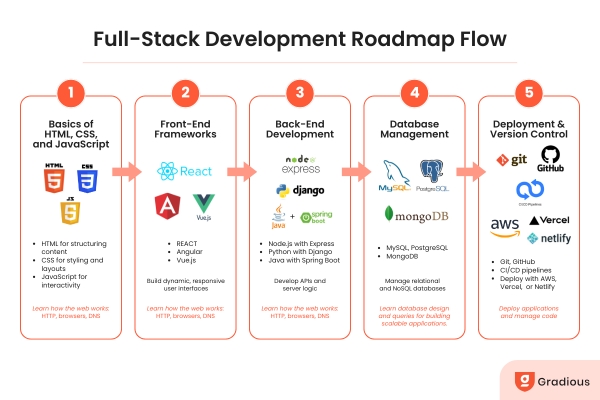
Step 1: Basics of HTML, CSS, and JavaScript
To begin with, you need to learn the foundational technologies of the web:
In addition, understanding how the web works, such as HTTP, browsers, and DNS, will strengthen your fundamentals.
For authoritative documentation, refer to MDN Web Docs
Step 2: Front-End Frameworks
Once you are acquainted with JavaScript, the next step is learning modern front-end frameworks such as:
These tools allow you to build dynamic, responsive, and scalable user interfaces. Moreover, they are widely used in real-world applications, making them essential for career growth.
Step 3: Back-End Development
After mastering the front-end, focus on back-end technologies:
At this stage, you will learn how to build APIs, handle server logic, and manage user authentication. This step connects your front-end interface with data processing systems.
Step 4: Database Management
Next, learn how to store and retrieve data efficiently:
Understanding database design and queries is critical for building scalable applications.
Step 5: Deployment & Version Control
Finally, learn how to deploy applications and manage code:
These skills ensure your applications are production-ready and maintainable.
To fast-track your journey, explore Full-stack Development courses
Data science focuses on extracting meaningful insights from data to support decision-making. It combines programming, statistics, and machine learning to solve complex problems.
While both roles work with data:
This field is ideal for those who enjoy working with data, patterns, and analytical thinking.
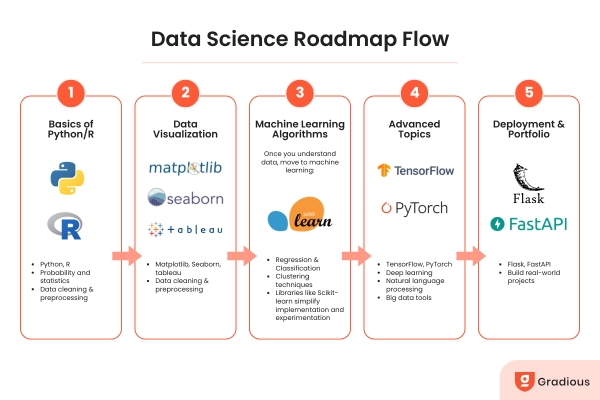
Step 1: Basics of Python/R, Statistics, and Data Handling
Start with programming and mathematical foundations:
Also, learn data cleaning and preprocessing, as real-world data is often unstructured.
Step 2: Data Visualization
Next, focus on presenting insights effectively:
Visualization helps translate complex data into clear, actionable insights.
Step 3: Machine Learning Algorithms
After understanding data, move to machine learning:
Libraries like Scikit-learn simplify implementation and experimentation.
Step 4: Advanced Topics
After building a strong foundation, explore advanced areas:
These skills open opportunities in AI-driven roles.
Step 5: Deployment & Portfolio Building
Finally, focus on applying your knowledge:
You can also practice on Kaggle Tutorials to strengthen your skills.
To get structured guidance, explore Data Science training programs.
Cloud computing enables businesses to store data, run applications, and scale infrastructure over the internet. It has become a core part of modern IT systems.
Major platforms include:
As companies extensively adopt cloud technologies, the demand for cloud professionals continues to grow in the IT industry.
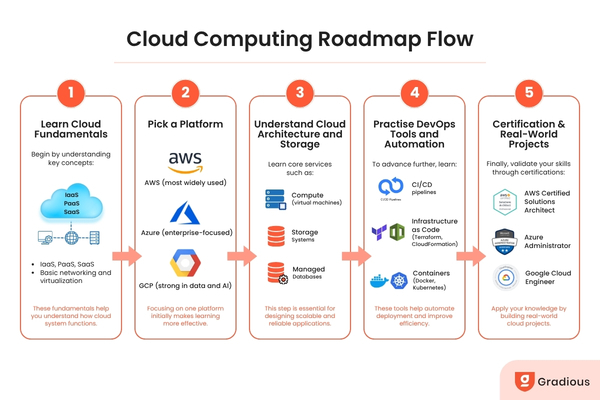
Step 1: Learn Cloud Fundamentals
Begin by understanding key concepts:
These fundamentals help you understand how cloud systems function.
Step 2: Pick a Platform
Next, choose a platform to specialize in:
Focusing on one platform initially makes learning more effective.
Step 3: Understand Cloud Architecture and Storage
Learn core services such as:
This step is essential for designing scalable and reliable applications.
Step 4: Practice DevOps Tools and Automation
To advance further, learn:
These tools help automate deployment and improve efficiency.
Step 5: Certification & Real-World Projects
Finally, validate your skills through certifications:
You can explore AWS Training & Certification
For hands-on learning, check out career-ready tech programs at Gradious
Following a structured roadmap for tech careers offers several advantages.
A roadmap helps you focus on essential skills, enabling quicker and more efficient learning.
It provides a clear sequence, making it easier to track your growth and stay motivated.
Structured learning aligns your skills with industry requirements, improving employability.
Instead of jumping between random resources, a roadmap gives you direction and clarity.
By emphasizing hands-on projects, it ensures you gain real-world experience.
As you progress step by step, your confidence grows, keeping you motivated.
A roadmap allows you to combine skills across fields, such as integrating cloud with full-stack or data science.
Building a successful career in the IT domain requires more than just learning; it requires direction. A structured roadmap for tech careers helps you stay focused, avoid confusion, and achieve your goals efficiently.
Whether you choose full-stack development, data science, or cloud computing, the key is to follow a step-by-step approach, practice consistently, and build real-world projects.
In the long run, this structured path will not only improve your skills but also position you for long-term success in the tech industry.
Start your journey today! Explore our courses and roadmaps for tech careers and achieve your dream role in full-stack, data science, or cloud computing.
Visit: https://gradious.com/