
Artificial Intelligence is transforming industries at a rapid pace, and software engineering is no exception. As AI-powered tools become more advanced, many aspiring developers and working professionals are asking an important question: How is AI changing software engineering jobs in 2026?
The reality is that AI is not eliminating software engineering careers. Instead, it is reshaping how developers work, the skills they need, and the career opportunities available in the technology industry. From AI-assisted coding and automated testing to new roles in machine learning, cloud infrastructure, Enterprise AI, and Intelligent Automation, the profession is evolving quickly.
For anyone planning a future in technology, understanding this shift is essential. Let’s explore the AI impact on software developers and what it means for the future of software engineering in 2026.
The software development industry has changed significantly over the last few years. Traditionally, developers spent a large part of their time writing code manually, debugging issues, testing features, and maintaining documentation. Today, AI tools can support many of these activities.
Modern AI-powered development platforms can generate code snippets, suggest improvements, detect bugs, explain code, and automate repetitive processes. As a result, software engineers are spending less time on routine tasks and more time solving complex business and technical challenges.
This shift highlights the growing AI impact on software developers. Rather than replacing engineers, AI is becoming a productivity partner that helps teams build, test, and maintain software more efficiently.
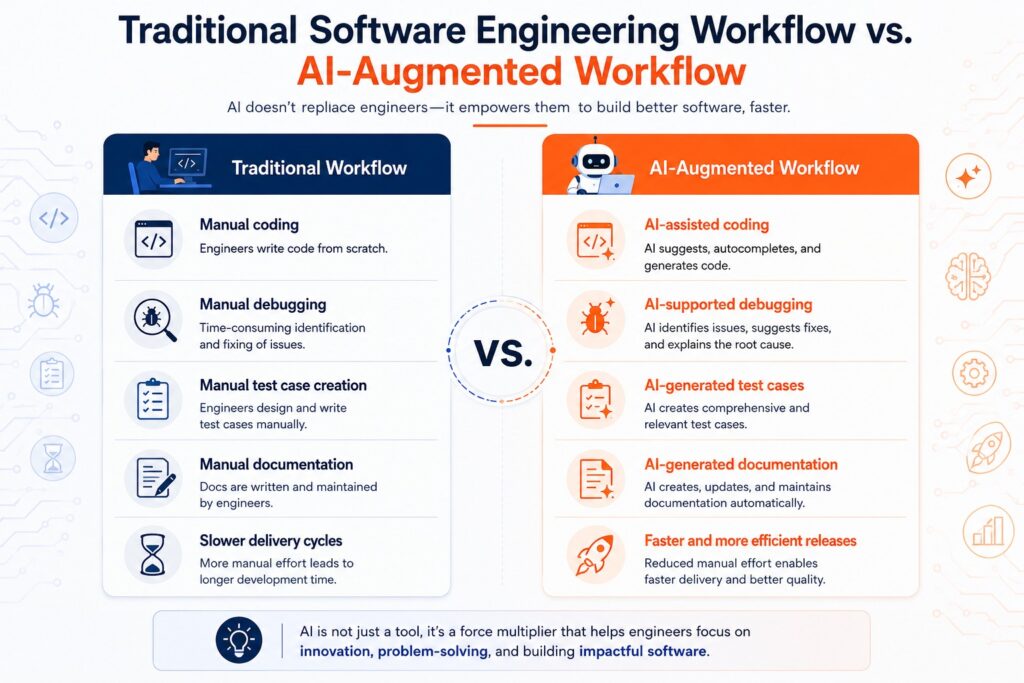
AI is changing the daily workflow of software engineers by supporting them across every stage of the software development lifecycle. From understanding requirements and writing code to testing, debugging, documentation, and deployment, AI tools are helping developers work faster and more efficiently.
Instead of spending most of their time on repetitive tasks, software engineers are now focusing more on solution design, problem-solving, system architecture, code quality, and business outcomes. This does not reduce the importance of developers; rather, it increases the need for engineers who can use AI tools effectively while applying strong technical judgment.
One of the most visible changes in software engineering is the rise of AI-assisted coding. Tools such as ChatGPT, GitHub Copilot, Cursor, Gemini, and Claude can help developers write and improve code faster.
These tools can:
As a result, developers can focus more on solution design, logic, system architecture, and business requirements instead of writing repetitive code from scratch.
Testing is another area where AI is creating a major impact. AI-powered testing tools can help generate test cases, identify bugs, detect vulnerabilities, and predict potential software failures.
This leads to:
Consequently, engineering teams can release applications faster while maintaining better quality and reliability.
Documentation has always been one of the most time-consuming tasks for developers. However, AI can now help teams create and maintain documentation more efficiently.
AI tools can:
Additionally, AI-powered project management tools help teams track progress, prioritize tasks, identify blockers, and improve collaboration.
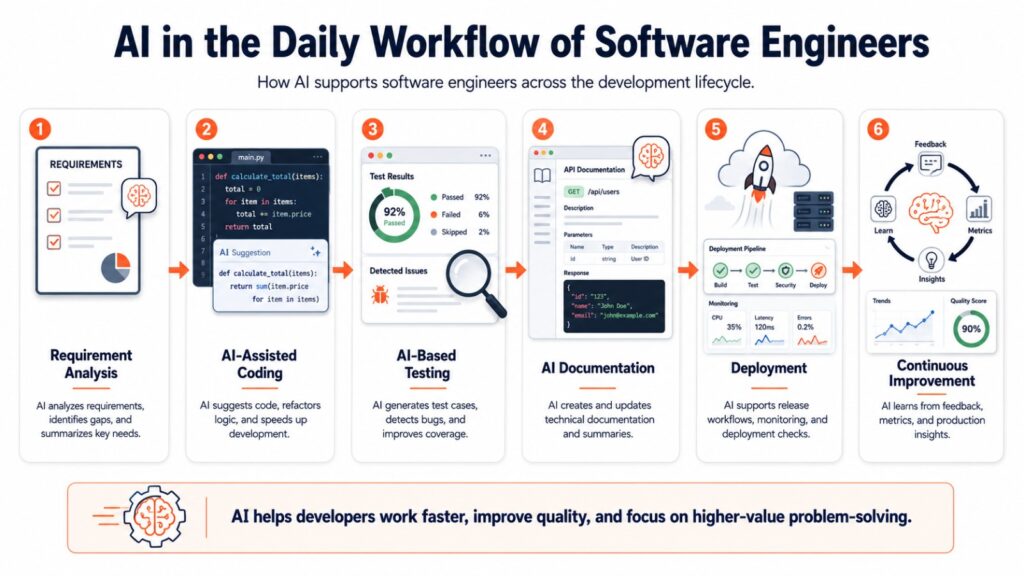
This flow shows how AI supports developers across the complete software development lifecycle, from planning to deployment.
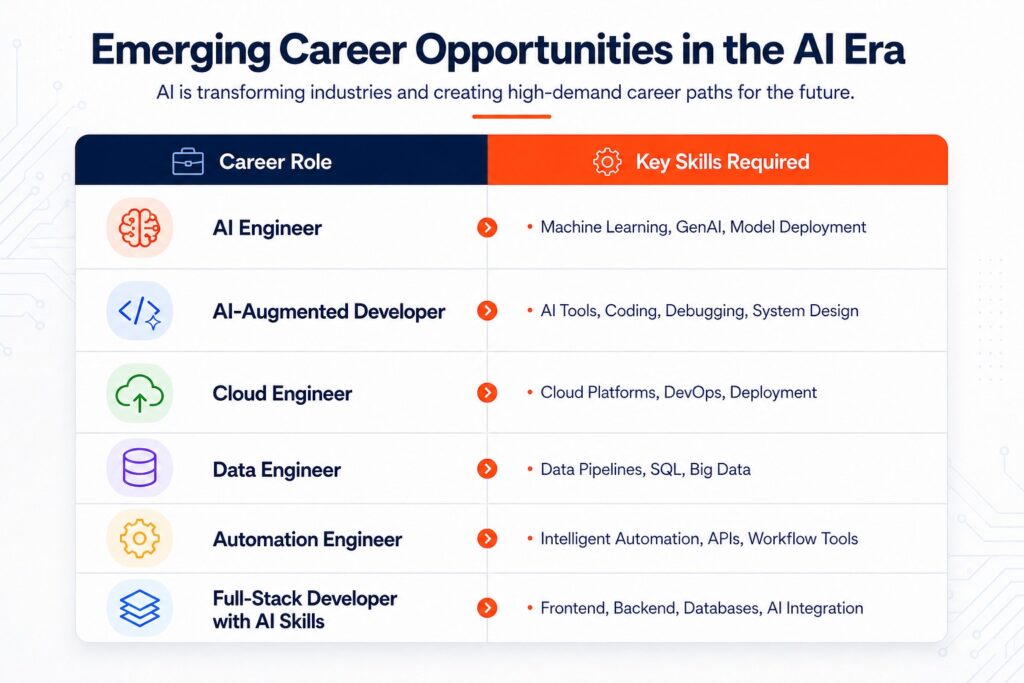
While some repetitive tasks are being automated, new and expanded career opportunities are emerging for software professionals. Organizations are now looking for developers who can combine software engineering knowledge with AI awareness, cloud skills, data understanding, and business problem-solving.
Rise of AI Engineer Roles
Enterprises increasingly need professionals who can build, train, integrate, and deploy AI-powered systems. This has created strong demand for AI engineers who understand machine learning, data pipelines, model deployment, cloud platforms, and AI application development.
These professionals work on:
Growth of AI-Augmented Developers
Another important trend is the rise of AI-augmented developers. These professionals use AI tools to improve productivity while applying their engineering knowledge to solve real-world problems.
Companies now value developers who can collaborate effectively with AI tools, validate AI-generated outputs, and make strong technical decisions.Companies now value developers who can collaborate effectively with AI tools, validate AI-generated outputs, and make strong technical decisions. This makes human judgment, code review, architecture thinking, and responsible AI usage more important than ever.
Demand for Cloud and Data Skills
AI systems require scalable infrastructure, secure deployment environments, and large volumes of high-quality data. As a result, cloud computing, DevOps, data engineering, and database optimization skills are becoming highly valuable.
AI systems require scalable infrastructure, secure deployment environments, and large volumes of high-quality data. As a result, cloud computing, DevOps, data engineering, and database optimization skills are becoming highly valuable.
For students exploring the future of software engineering, following a structured career plan can make a significant difference. Check out this roadmap: Step-by-Step Roadmap for Tech Careers.
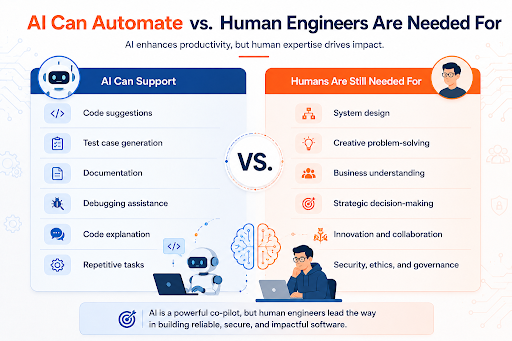
This is one of the most frequently asked questions in the technology industry. The answer is clear: AI will automate certain tasks, but it will not fully replace skilled software engineers.
What AI Can Automate
AI can support or automate tasks that are repetitive, predictable, and rule-based, including:
These capabilities improve efficiency and reduce development time.
What AI Cannot Replace
Despite its advancements, AI still lacks many critical human abilities. Software engineers remain essential for:
Simply put, AI can generate code, but it cannot fully understand business context, customer expectations, long-term technical strategy, or organizational priorities without human guidance.
If you are just starting your journey, learn the fundamentals through programming basics to build strong development skills.
Developing strong developer skills for the AI era will help you remain competitive regardless of technological changes.
To succeed in the AI era, software engineers need more than just coding knowledge. They must combine strong programming fundamentals, problem-solving skills, AI tool proficiency, system design knowledge, and an understanding of how technology solves real business problems.
As AI takes over more repetitive development tasks, companies are looking for engineers who can think critically, design scalable systems, validate AI-generated outputs, and build secure, reliable applications. The most successful developers will be those who know how to use AI as a productivity partner while continuing to strengthen their core technical skills.
Modern developers should learn how to use AI tools effectively to improve their daily workflows. Some popular AI tools for developers include:
Learning how to use these platforms responsibly can significantly improve productivity. However, developers should also know how to review, test, and validate AI-generated code before using it in real-world applications.
Problem-Solving Skills
As AI takes over more routine coding tasks, problem-solving becomes even more valuable.
Software engineers should focus on developing:
Employers continue to value these skills because they are difficult to automate and essential for building reliable software systems.
Building Real-World Projects
Employers prioritize practical experience over theoretical knowledge. Real-world projects help students and professionals demonstrate their ability to apply concepts in practical scenarios.
Create projects that demonstrate:
You can also strengthen your profile through industry-recognized certifications. Upgrade your career with the best tech certifications for high-paying jobs and stay competitive in the AI-driven technology market.
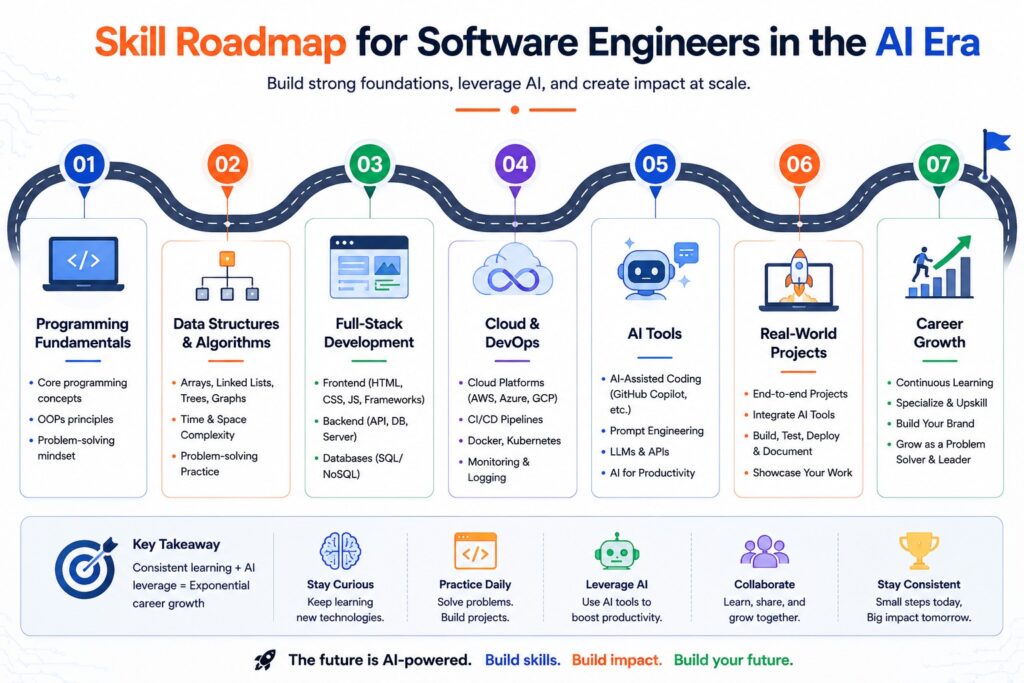
This roadmap helps learners understand how to build a strong foundation before moving into AI-powered software development.
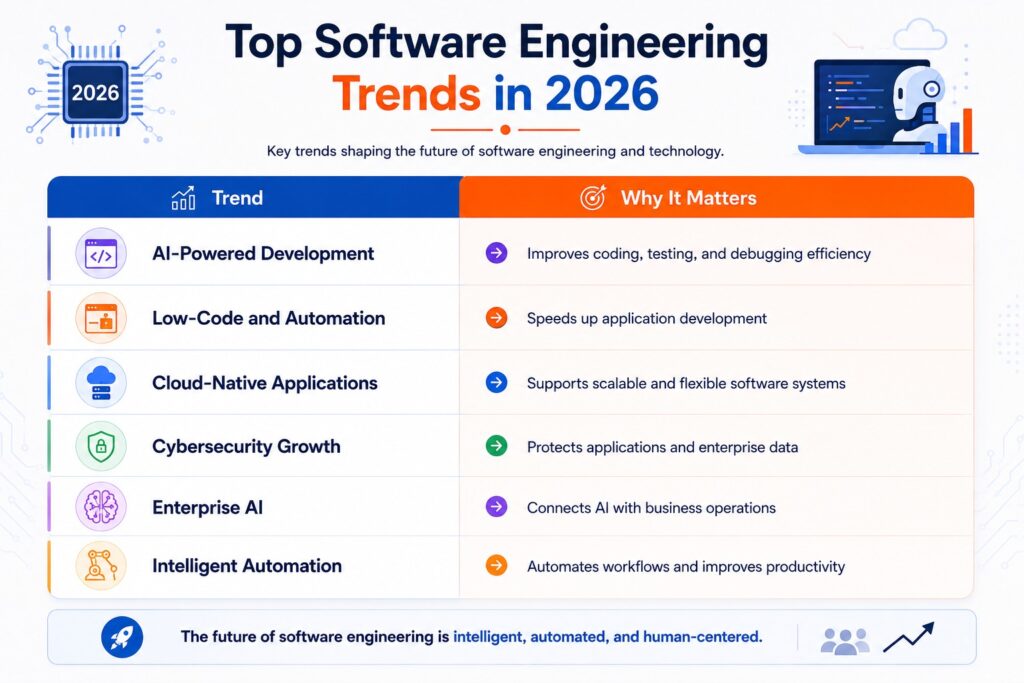
Here are the key software engineering trends shaping the industry in 2026. These trends show how AI, cloud, automation, cybersecurity, and enterprise technology are influencing the way modern software is designed, developed, deployed, and maintained.
AI assistants are becoming standard tools within development environments. They help engineers write, test, review, debug, and maintain code more efficiently.
Low-Code and Automation
Organizations are increasingly adopting low-code and automation platforms to accelerate application development and reduce delivery timelines. However, strong software engineering knowledge is still required to build scalable, secure, and maintainable systems.
Cloud-Native Applications
Cloud computing continues to drive innovation. Skills in cloud architecture, DevOps, containerization, APIs, and deployment pipelines are becoming highly valuable for modern developers.
Cybersecurity Growth
As digital systems become more complex, cybersecurity remains a critical focus area. Enterprises need developers who can build secure, resilient, and compliant applications.
Enterprise AI and Intelligent Automation
Businesses are using AI in Business Operations to improve efficiency, automate workflows, analyze data, and support decision-making. This creates opportunities for developers who understand software engineering, AI integration, automation, and business processes.
Understanding these trends will help professionals prepare for the evolving future of software engineering.
The impact of AI on software engineering jobs in 2026 is significant, but it should not be viewed only as a threat. AI is transforming software development by automating routine tasks, improving productivity, supporting better testing, and creating new career paths.
Developers who embrace AI, learn emerging technologies, and strengthen their problem-solving abilities will have access to exciting opportunities in the years ahead.
Want to Stay Ahead in the AI-Driven Tech Industry?
Start building future-ready software engineering skills today. Learn programming fundamentals, work on real-world projects, explore AI-powered development tools, and continuously upgrade your knowledge to stay competitive in 2026 and beyond.
To summarize, AI is changing software engineering jobs in 2026 by transforming how developers work. It is not about replacing developers completely; it is about changing the role of software engineers and increasing the importance of higher-value skills.
AI is becoming an essential part of the software development process, helping engineers build better products faster. Developers who learn AI tools, strengthen their technical foundations, build real-world projects, and adapt to industry changes will continue to grow.
The future belongs to developers who combine human creativity, engineering discipline, business understanding, and the power of artificial intelligence.