
Campus hiring is no longer just about organizing recruitment drives. As employer expectations grow and hiring becomes highly skills-focused, colleges need to manage much more than applications and interviews. Placement teams must understand student capabilities, track career readiness, manage employer relationships, coordinate recruitment workflows, and turn placement data into actionable insights.
However, many placement cells still rely on spreadsheets, emails, disconnected records, and manual processes. Well, this model may work at a smaller scale, but as campus recruitment becomes more complex, colleges need a smarter approach.
This is where a Placement Operating System can play a role, an integrated digital ecosystem that unifies student readiness, skill development, placement operations, employer engagement, recruitment workflows, and placement data.
The shift is from managing individual placement activities to managing the broader journey toward career outcomes.
Traditional placement cells play a critical role in connecting students with employers. However, many of their processes are fragmented.
Placement teams often manage multiple things in parallel.
When these activities are spread across spreadsheets, emails, and multiple systems, administrative work increases and visibility decreases. This directly affects placement team efficiency.
Academic performance provides only one part of a student’s profile, but a modern placement process also needs visibility into:
Without structured student skill tracking, colleges may identify skill gaps only when students begin applying for jobs. This makes preparation reactive instead of continuous.
Colleges can help students build relevant capabilities earlier by following a structured step-by-step roadmap for tech careers, particularly across areas such as full-stack development, data science, and cloud computing.
Recruiter relationships are another important part of campus hiring. However, employer information may be spread across files, emails, and individual records. This can make it difficult for placement teams to understand:
Placement data is frequently used to answer questions such as:
These are important metrics. However, they mainly explain what happened. A modern placement strategy also needs to understand why it happened and what should improve next. This necessitates a shift from simple reporting to a data-driven placement approach.
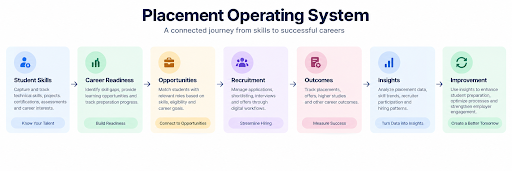
A Placement Operating System can be understood as a connected digital ecosystem that brings together student readiness, skill development, placement operations, employer engagement, recruitment workflows, and placement data.
Instead of treating placement as a series of recruitment events, it connects the complete journey:
Student skills → Career readiness → Opportunities → Recruitment → Outcomes → Insights → Improvement
The goal is not simply to digitize the placement cell; it is to create an interconnected system that helps institutions continuously improve how they prepare students and manage campus hiring.
Generally, a traditional placement model focuses highly on managing recruitment drives.
In contrast, a placement operating system focuses on the broader outcome:
This creates a shift from activity management to outcome management.
Instead of maintaining a basic student record, colleges can build richer profiles that unify:
This provides a more complete view of student readiness.
| Traditional Placement Cell | Placement Operating System |
| Manual data management | Centralized data |
| Spreadsheet-based tracking | Digital workflows |
| Generic student preparation | Skill-based preparation |
| Manual eligibility checks | Automated and configurable workflows |
| Fragmented employer information | Structured employer intelligence |
| Placement-season focused | Continuous readiness |
| Periodic reporting | Ongoing insights |
| Outcome reporting | Outcome analysis and improvement |
The difference is not simply technology; it is the shift from reactive placement management to proactive career readiness.
A connected system allows institutions to bring student preparation, industry requirements, recruitment opportunities, and placement outcomes into a single operating model.
A modern system should provide visibility into:
This helps colleges understand where students are today and what they need to develop next.
Student preparation should reflect changing industry requirements. A modern placement ecosystem can help institutions understand:
This creates a stronger connection between academic preparation and modern hiring needs.
A placement operating system can reduce repetitive administrative work across:
The objective of POS is not to replace placement teams but rather to give them more time to focus on students and employers.
A structured employer layer can help colleges manage:
This strengthens employer engagement for colleges while making recruiter interactions more organized.
Placement analytics can help institutions track:
AI can add another layer of intelligence to campus hiring. Potential applications include:
However, AI should complement the placement operating system, not become a substitute for institutional judgment.
Instead of relying only on final placement numbers, institutions can analyze:
The hiring environment is changing as employers place greater emphasis on skills, practical capabilities, and role-specific readiness.
According to the World Economic Forum’s Future of Jobs Report 2025, AI and big data, networks and cybersecurity, and technological literacy are among the fastest-growing skills through 2030.
For colleges, this creates a clear need to connect learning and hiring more closely.
Academic performance remains relevant, but it does not provide a complete picture of job readiness. Students also need opportunities to demonstrate:
Career readiness should begin well before recruitment drives. Colleges can support continuous preparation through:
Matching Students with Relevant Opportunities
The recruitment process becomes more effective when institutions can connect:
Student skills → Role requirements → Eligibility → Opportunity → Interview → Outcome
This is the foundation of skill-based campus hiring.
A modern placement ecosystem needs more than recruitment workflows. It needs visibility into student capabilities, readiness, industry requirements, and outcomes.
Gradious Placement Operating System helps colleges move toward this model.
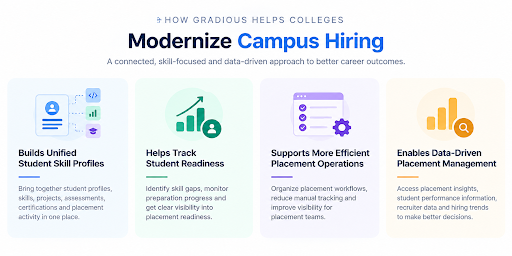
From our experience working across student development and hiring requirements, placement readiness cannot be treated as a final-year activity. The earlier institutions identify skill gaps and connect them to role requirements, the more time students have to build those capabilities.
Gradious POS brings together:
Its integrated system enables institutions to gain better visibility into:
As Gradious POS integrates everything, its connected approach can help placement teams:
Institutions can unify:
The future of campus hiring will not be defined by a single recruitment platform or annual placement season. Instead, colleges will need systems that connect the full student-to-career journey.
The traditional placement cell still remains an essential part of every institution. However, manual processes and fragmented information become harder to manage as campus hiring grows more complex.
A placement operating system provides a connected approach by integrating different layers of placement preparation and operations.
The future of campus hiring is not simply about conducting more placement drives. It is about building an ecosystem that continuously prepares, connects, measures, and improves career outcomes. Gradious Placement Operating System helps colleges move toward this model.
Ready to move beyond the traditional placement cell?
Explore how Gradious POS can help your institution build a more connected, skill-focused, and data-driven approach to campus hiring.