
For engineering colleges, placement season is becoming harder to predict. Students are graduating with degrees, yet many are finding it difficult to convert academic qualifications into relevant software and technology jobs. At the same time, companies are still hiring, but they are becoming more selective about the skills, projects, and job readiness they expect from freshers.
This has created a widening gap between what colleges teach, what students can demonstrate, and what employers actually need.
AI is accelerating this shift, but it is only part of the story. The larger change is happening across hiring expectations, business technology adoption, intelligent automation, and the move toward skills-first recruitment. So, what is really driving the pressure on engineering college placements in 2026, and what can colleges do about it?
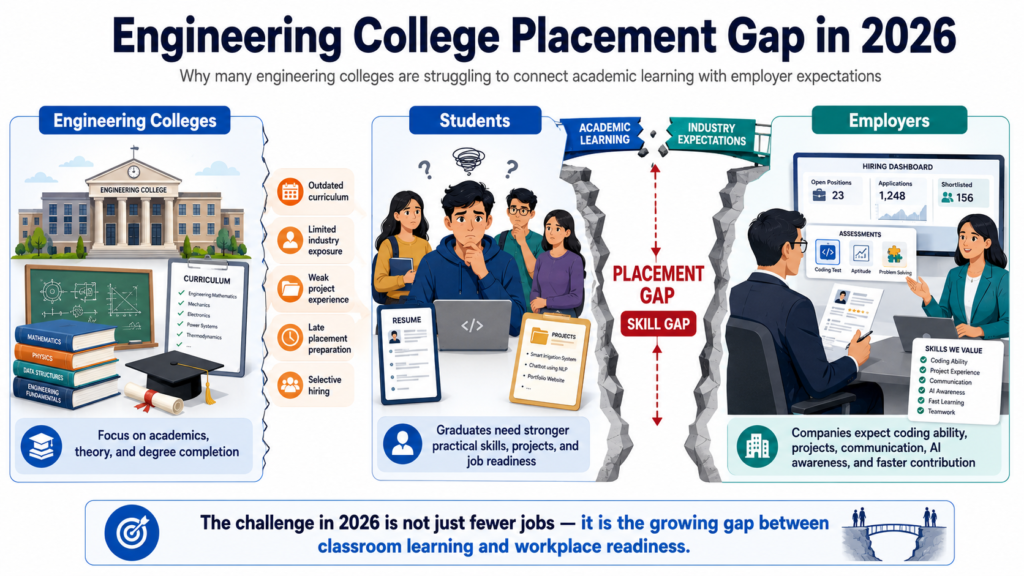
The placement challenge in 2026 is not caused by one factor. Several changes are happening at the same time:
This is one of the biggest engineering placement trends to watch: the shift from mass hiring to selective, skills-first hiring.
Earlier, large IT companies could recruit sizeable batches of graduates and train them after joining. Today, many employers want freshers who can contribute sooner. As a result, coding ability, real-world projects, internships, AI literacy, communication skills, and role-specific knowledge carry more weight during recruitment.
According to the World Economic Forum’s Future of Jobs Report 2025, analytical thinking remains one of the most important core skills for employers, while AI and big data, networks and cybersecurity, and technological literacy are among the fastest-growing skills. (World Economic Forum)
So, the problem is not simply fewer jobs. The hiring bar itself is changing.
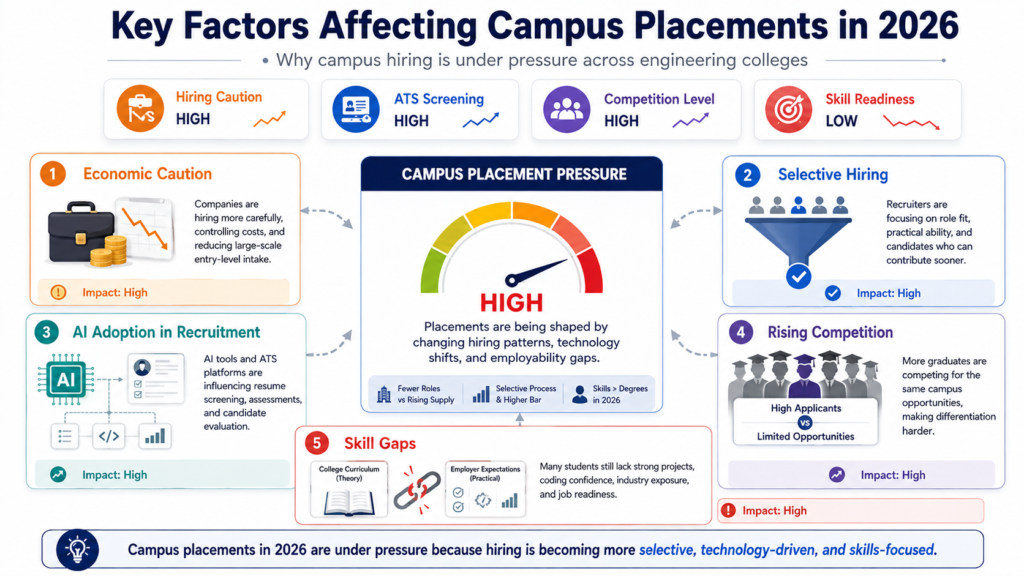
Here are the key factors driving placement challenges in 2026:
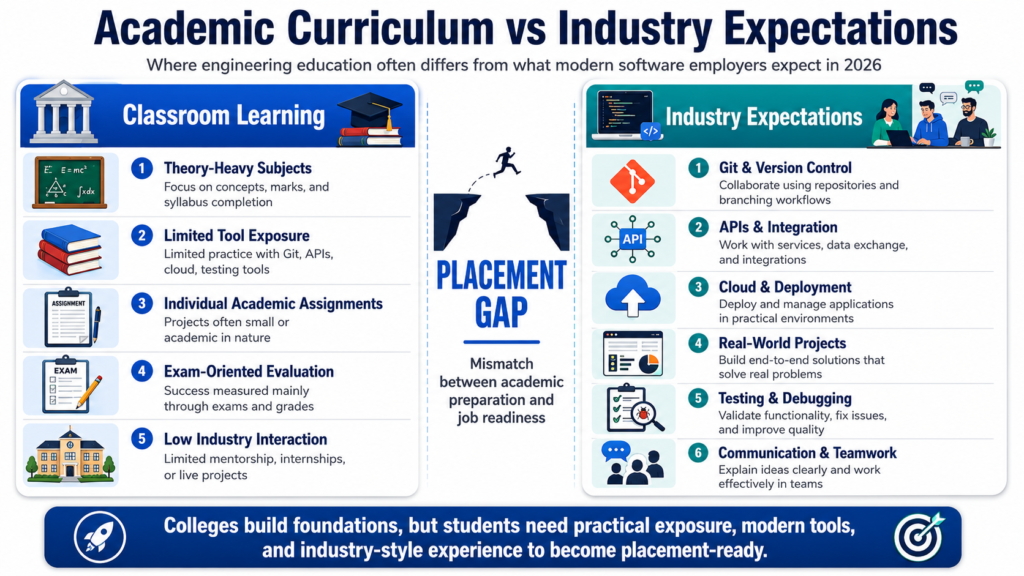
Technology is evolving faster than many college curricula. Students may understand programming, databases, or software concepts in theory, but they may not get enough exposure to the tools, workflows, and engineering practices used in real software teams.
Modern software roles often require familiarity with APIs, Git, cloud deployment, AI tools, testing, debugging, documentation, and collaborative development. Without practical exposure, students may struggle to perform well in technical assessments and interviews.
A degree does not automatically guarantee job readiness. Weak coding fundamentals, limited project experience, poor technical communication, and low exposure to real-world problem-solving can affect placement outcomes.
Recruiters increasingly look for candidates who can demonstrate what they know through projects, assessments, internships, and clear technical explanations.
Want to build industry-ready skills? Explore this Step-by-Step Roadmap for Tech Careers.
Students are competing on more than academic scores. Coding assessments, project quality, internships, technical skills, communication, and interview performance now influence hiring decisions.
As more graduates enter the job market, students who rely only on degree credentials may find it harder to stand out.
Many students interact with industry requirements only when placement season begins. Without internships, live projects, mentorship, industry-led assessments, or exposure to real business use cases, they may struggle to understand workplace expectations.
This gap becomes even more visible when companies expect freshers to understand how software is built, deployed, maintained, and used in business operations.
Short-term training in the final year cannot fully bridge years of skill gaps. Colleges need to build employability progressively from the early semesters instead of treating placement preparation as a last-minute activity.
A stronger approach is to combine programming, problem-solving, communication, projects, assessments, and industry exposure throughout the academic journey.
AI is changing both how companies hire and what they expect from engineering graduates.
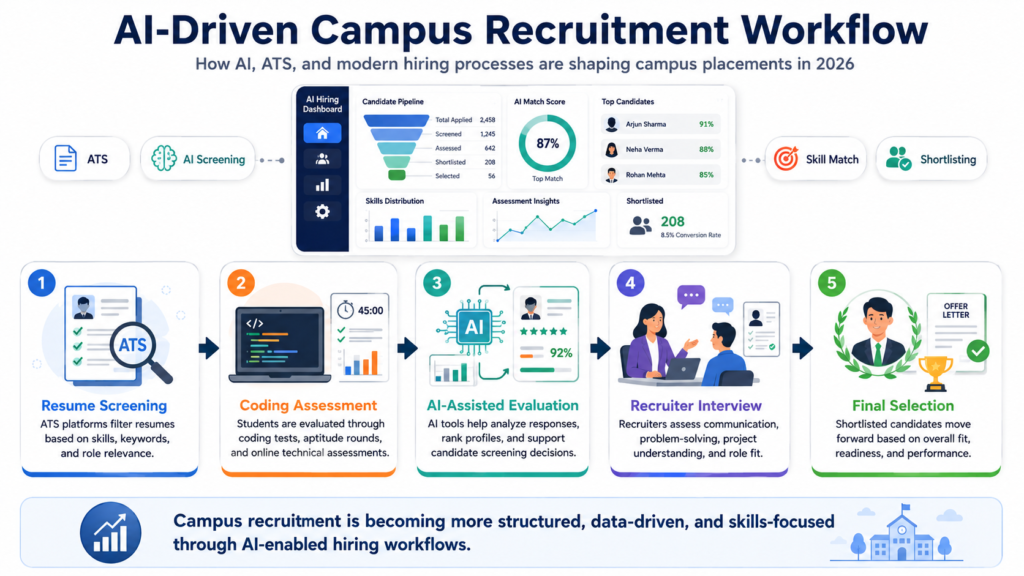
The key shifts include:
A degree remains important, but employers are assessing what candidates can actually do. Practical coding, projects, problem-solving, AI literacy, and the ability to learn quickly are becoming stronger hiring signals.
This does not mean degrees are losing value. It means degrees must be supported by proof of practical capability.
AI-powered screening tools and Applicant Tracking Systems can help filter resumes based on skills, experience, keywords, and job relevance before recruiters review them.
Therefore, students need clear, role-specific resumes rather than keyword-stuffed profiles. A strong resume should highlight projects, technical skills, internships, GitHub links, achievements, and measurable outcomes.
Companies are looking for graduates with practical skills in AI/ML, cloud computing, full-stack development, databases, data analytics, and related technology areas.
Enterprise AI, AI in business operations, and intelligent automation are also influencing entry-level expectations. Freshers do not need to be AI experts from day one, but they should understand how AI tools are used responsibly to improve productivity, support decision-making, automate repetitive tasks, and build smarter applications.
Students should build strong fundamentals before specializing in advanced technologies.
Build a strong technical foundation with Learn Programming Basics before specializing in advanced technologies.
AI is also influencing coding tests and technical evaluations. Recruiters can assess how candidates approach problems, explain solutions, debug code, and use AI tools responsibly.
The focus is not only on producing code. It is also about understanding the problem, validating the output, explaining trade-offs, and ensuring that the solution is correct, secure, and maintainable.
AI and intelligent automation can handle some routine tasks, so employers increasingly expect freshers to contribute faster in areas that require reasoning, implementation, collaboration, and adaptability.
Graduates who combine technical fundamentals, AI fluency, problem-solving skills, and project-based experience can stand out in a competitive market.
Companies are no longer evaluating freshers only on academic scores or degree credentials. Recruiters now look for practical capability, problem-solving ability, communication skills, and evidence that students can apply their learning in real software or business environments.
Practical coding goes beyond knowing syntax. Companies want graduates who can understand a problem, write maintainable code, identify bugs, work with APIs and databases, use version control, and explain their approach clearly.
This is especially important when AI tools can generate code quickly. Engineers still need to understand whether that code is correct, secure, efficient, and suitable for the problem.
Projects give recruiters evidence of applied knowledge. A strong project should demonstrate the problem being solved, the technologies used, the student’s contribution, the challenges faced, and the outcome.
Whenever possible, students should deploy their applications, maintain code in a public repository, and document their work clearly.
Internships add another layer of evidence by exposing students to real teams, deadlines, codebases, tools, communication practices, and workplace expectations.
Technical ability alone is not enough. During interviews, candidates need to explain their reasoning, ask relevant questions, discuss trade-offs, and communicate technical ideas clearly.
The U.S. Bureau of Labor Statistics projects that computer and information technology occupations will grow much faster than the average for all occupations from 2024 to 2034. However, Indian engineering students should treat such global data as broader context rather than a direct measure of Indian campus hiring. (Bureau of Labor Statistics)
Students need to build skills they can demonstrate during assessments and interviews. Here are the major areas to focus on:
Focus on strong fundamentals and one relevant specialization, such as AI/ML, cloud computing, full-stack development, data analytics, or cybersecurity. Avoid trying to learn every trending technology at once.
Work on 2–3 meaningful projects that demonstrate problem-solving and practical skills. Be ready to explain the technology, challenges, decisions, and your contribution.
A strong portfolio should show not just what you built, but why you built it and how it works.
Internships, live projects, hackathons, open-source contributions, and industry-led programs help students understand real workplace expectations and strengthen their resumes.
Even small practical experiences can make a difference when students can explain what they learned and how they applied it.
Regular coding practice, DSA, debugging, and technical assessments can improve performance in online tests and technical interviews.
Students should focus on consistency instead of last-minute preparation.
Students should practise explaining projects, answering technical questions, and communicating their approach clearly.
Good communication does not mean speaking perfect English. It means being able to explain ideas, clarify assumptions, and discuss solutions with confidence.
Certifications can support a career path, but they should complement, not replace, practical skills and projects.
A certification is most useful when students can apply the knowledge in a project, assessment, or interview.
Looking to build an ATS-friendly portfolio? Explore Resume Tips That Will Get You Hired in 2026. Present your skills and experience effectively to attract recruiters.
To improve campus placement outcomes, engineering colleges need a structured employability approach instead of last-minute placement training. This means connecting curriculum, technical training, project-based learning, assessments, industry exposure, and interview preparation throughout the student journey.
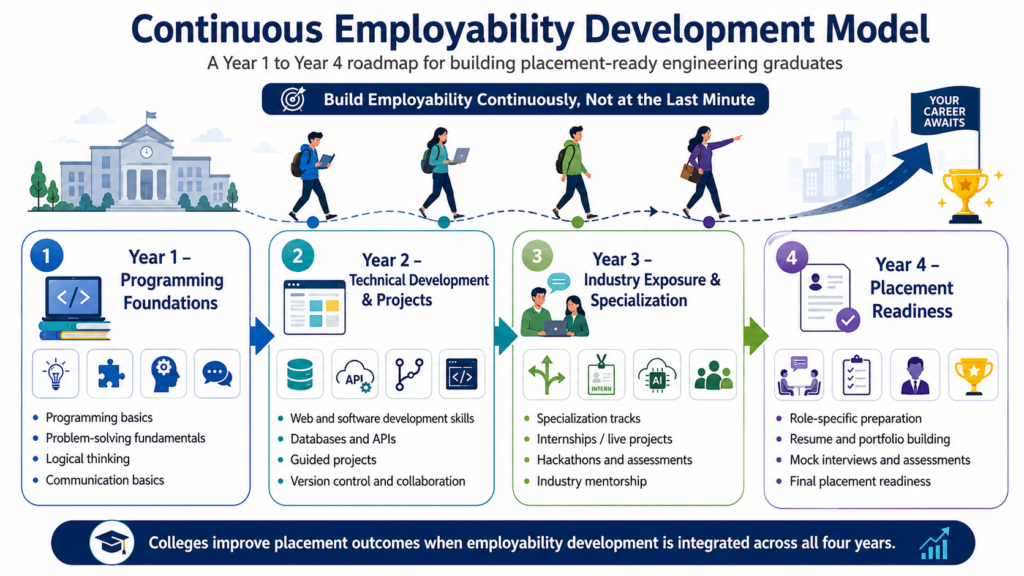
Colleges should maintain strong engineering fundamentals while continuously aligning practical learning with industry requirements.
Regular input from employers, alumni, recruiters, and technical experts can help identify which skills are becoming important and where students need additional exposure.
Curriculum improvement should not mean replacing fundamentals with trends. It should mean connecting fundamentals with real-world application.
Industry partnerships should go beyond occasional guest lectures.
Live projects, mentorship, internships, technical assessments, hackathons, curriculum reviews, mock interviews, and employer-led workshops can expose students to real workplace expectations.
Colleges can also collaborate with technology companies to introduce structured training in AI, full-stack development, cloud computing, data, and intelligent automation.
Projects should begin well before the final placement season.
A practical progression could look like this:
Foundation → Guided project → Team project → Industry-style project → Capstone
This gives students several opportunities to build, fail, improve, and explain their work.
Project-based learning also helps students develop ownership, debugging ability, teamwork, documentation habits, and presentation skills.
Placement preparation should not begin a few months before graduation. Instead, colleges can build employability progressively:
Colleges should also measure placement quality, not just placement percentage. Technical-role placement, median salary, internship-to-PPO conversion, employer feedback, role relevance, and retention can provide a clearer picture of outcomes.
The future of engineering graduates’ careers will be more skill-driven, role-specific, and evidence-based.
We can expect:
However, this does not mean campus placements are disappearing. Instead, they are becoming more segmented.
Students targeting software development, AI, cloud, cybersecurity, data, GCC roles, or product engineering will increasingly need different preparation pathways.
For colleges, this means the key question is changing from “How many students can we place?” to “How many students are ready for specific roles?”
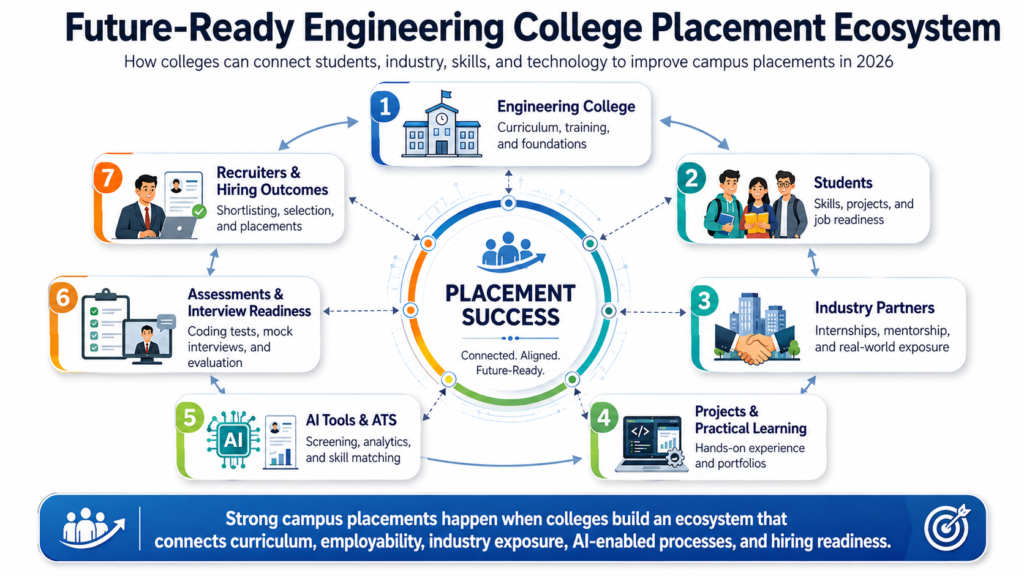
The pressure on engineering college placements in 2026 is not simply a result of fewer jobs. Changing hiring practices, AI adoption, economic caution, intense competition, and the growing gap between academic learning and workplace skills are all reshaping recruitment.
However, the opportunity is still significant.
Engineering graduates who build strong fundamentals, develop practical skills, complete meaningful projects, and keep learning can remain competitive in the changing job market.
Likewise, colleges that move from last-minute placement training to continuous employability development can create stronger outcomes for students, recruiters, and institutions.
Want to Ace Campus Placements?
Master in-demand technologies, build real-world projects, and become job-ready with industry-focused training programs from Gradious.
For colleges, the bigger opportunity is to build a structured employability pathway that connects curriculum, technical training, projects, assessments, industry exposure, and placement preparation.