
You have completed your degree, learned programming languages, built a few projects, and applied to dozens of jobs. However, interview calls are limited, and job offers feel even harder to secure. If this sounds familiar, you are not alone.
Many freshers are struggling to get software jobs in 2026 not because software careers have disappeared, but because hiring expectations have changed. Employers now look for candidates who are job-ready, practical, adaptable, and capable of contributing from the early stages of employment.
Today, recruiters expect more than academic knowledge. They look for practical coding skills, real-world project experience, problem-solving ability, communication skills, and awareness of modern technologies such as AI-powered development tools, cloud computing, automation, and Agile workflows.
In this article, you will learn why freshers are struggling to land software roles, what recruiters expect in 2026, and the practical steps you can take to stand out and build a successful software career.
Software careers still offer strong long-term opportunities, but the entry-level hiring market has become more competitive and selective. One of the biggest career challenges for freshers is keeping up with changing employer expectations instead of relying only on a degree.
Over the past few years, companies have gradually shifted from degree-based hiring to skills-first recruitment. Instead of evaluating candidates only on academic performance, recruiters now focus on whether they can solve problems, write clean code, understand development workflows, collaborate with teams, and adapt to modern software practices.
As a result, freshers who depend only on classroom learning often struggle to stand out. Academic knowledge is important, but .
Another important change is the growing adoption of AI-powered development tools, cloud technologies, DevOps practices, and Agile workflows. These technologies have transformed how software is designed, built, tested, deployed, and maintained. Therefore, employers expect freshers to have at least a basic understanding of these tools before entering the workforce.
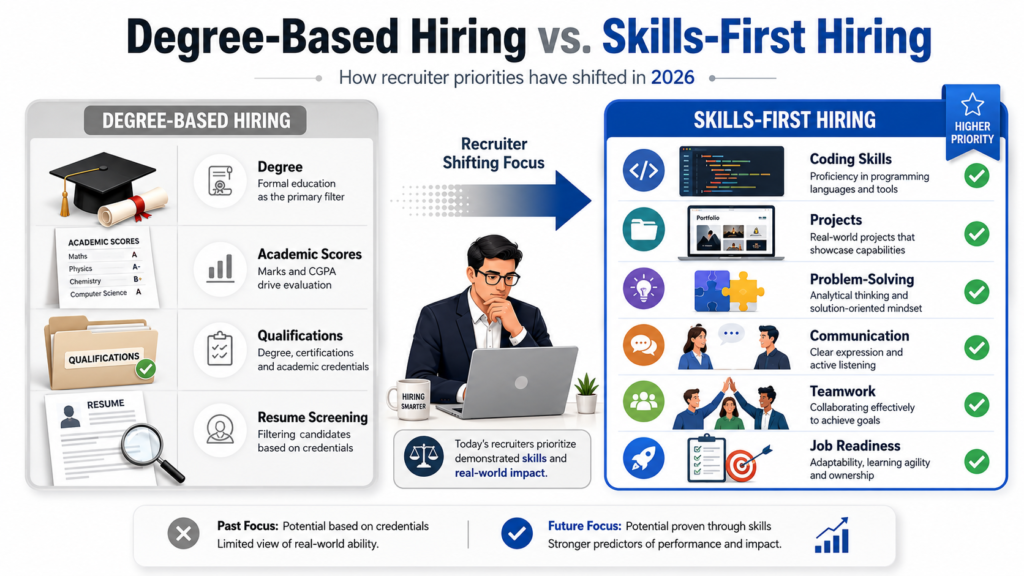
Several factors have widened the gap between academic learning and industry expectations. Understanding these challenges can help freshers prepare better and improve their chances of landing a software role.
Many graduates understand programming concepts but struggle to apply them in real-world scenarios. Employers prioritize candidates who can build applications, debug code, solve practical problems, and explain their approach clearly during interviews.
For example, knowing the syntax of a programming language is not enough. Freshers should know how to write clean code, handle errors, work with data, use APIs, and solve coding problems with logical thinking.
Strengthen your fundamentals by following the Gradious Learn Programming Basics guide before applying for software roles.
Academic projects alone may not be enough to impress recruiters. Employers look for hands-on experience that demonstrates your ability to build applications using APIs, databases, Git, deployment tools, and user-focused features.
A well-maintained GitHub portfolio with a few meaningful projects can add more value than several basic classroom assignments. Recruiters want to see whether you can apply your learning to practical problems.
Competition for entry-level tech jobs in 2026 has increased. More graduates are entering the market, while companies are becoming more selective in their hiring process.
Many organizations now use coding assessments, resume screening tools, and structured interview processes to identify job-ready candidates. This means freshers need to prepare strategically rather than apply randomly.
According to current employment and technology hiring trends, employers continue to value practical skills, adaptability, career readiness, and continuous learning along with academic qualifications.
A major skills gap in the IT industry exists because many freshers are unfamiliar with actual software development workflows. Companies expect candidates to understand Git, Agile practices, testing, collaboration, documentation, and the software development life cycle.
Along with technical knowledge, communication, teamwork, and problem-solving skills are also important. Software engineers do not work in isolation; they collaborate with developers, testers, designers, product teams, and clients to build reliable software solutions.
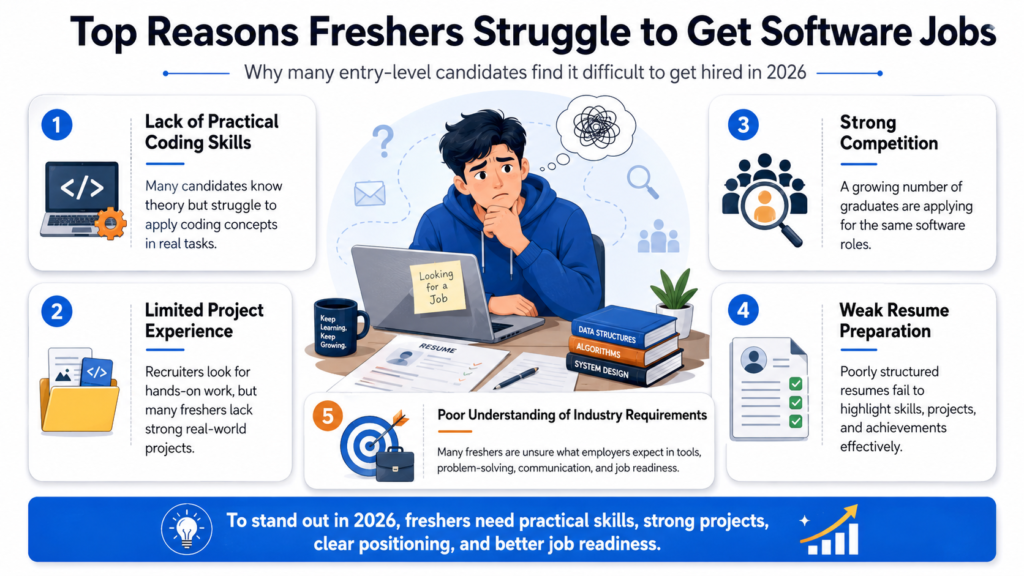
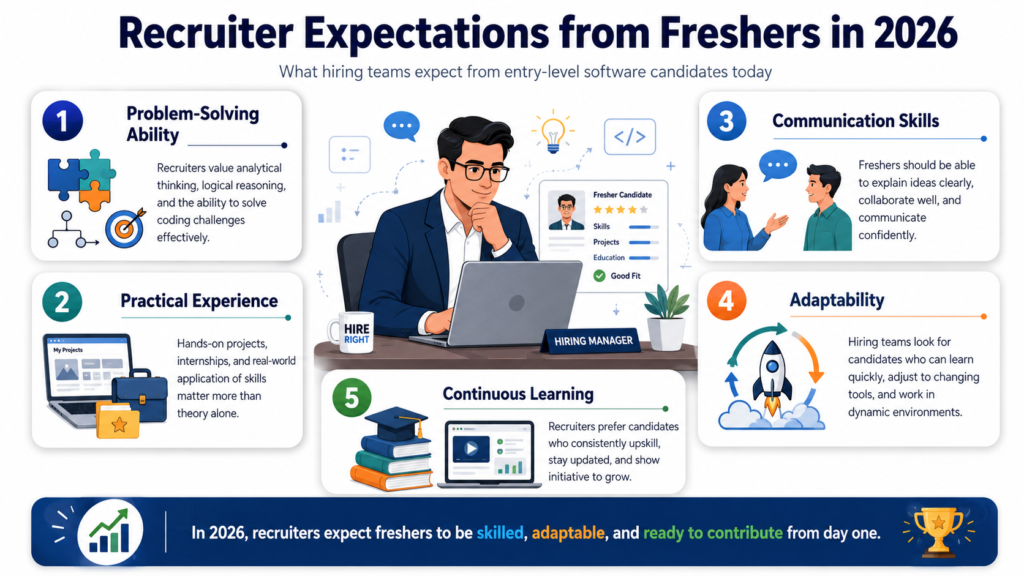
Understanding what recruiters expect can help you prepare strategically instead of applying to jobs without a clear plan. In 2026, companies are looking for freshers who can demonstrate both technical ability and workplace readiness.
Employers want candidates who can think logically, write efficient code, and explain their approach during technical discussions. Strong problem-solving skills show that you can handle real development challenges and not just memorize answers.
Recruiters often review GitHub repositories, personal projects, internships, freelance work, hackathon participation, or open-source contributions to understand how candidates apply their knowledge beyond the classroom.
Software engineers work closely with developers, testers, designers, product teams, and business stakeholders. Candidates who communicate clearly, ask thoughtful questions, and explain their ideas confidently often leave a stronger impression during interviews.
Technology evolves rapidly. Companies want professionals who are eager to learn new tools, adapt to change, and continuously improve their skills. This is especially important as AI-powered development, Enterprise AI, cloud platforms, and Intelligent Automation become more common in business operations.
Employers today are looking for candidates with a balanced mix of technical expertise, practical exposure, and professional readiness. Mastering the right skills can significantly improve your chances of getting hired for software jobs.
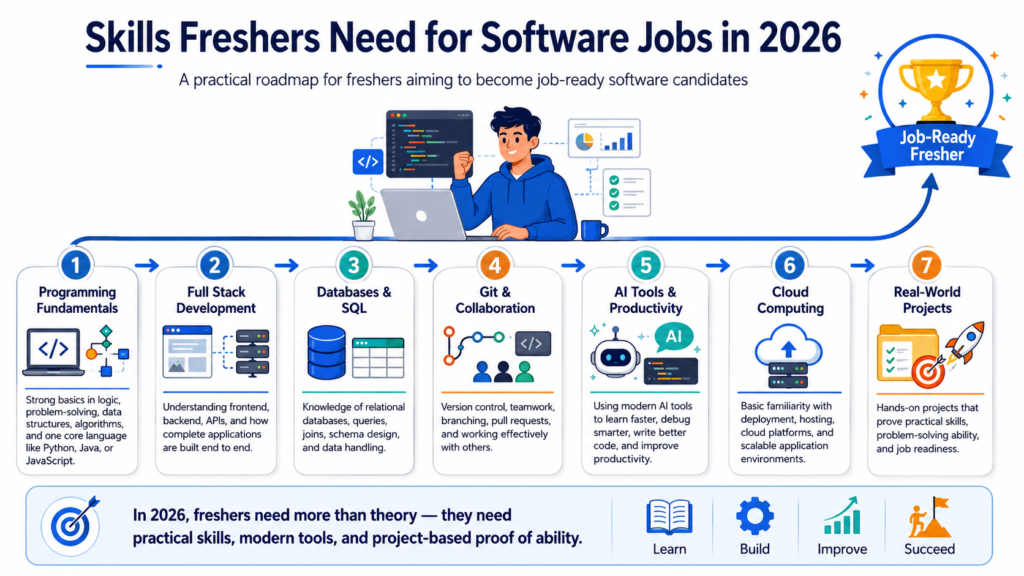
Focus on languages such as Python, Java, or JavaScript, and strengthen your understanding of data structures, algorithms, object-oriented programming, and problem-solving.
These concepts are frequently tested during coding interviews and form the backbone of software development. Strong fundamentals also help you learn new frameworks and tools faster.
Beyond programming, employers expect freshers to understand how modern applications are built.
Learn Full Stack Development, REST APIs, databases, Git, testing fundamentals, and basic deployment concepts. Building projects with these technologies helps you demonstrate practical knowledge and confidence during interviews.
AI is transforming software development, making it important for freshers to understand how to use AI-powered coding assistants responsibly. However, AI tools should support your learning, not replace your understanding.
Freshers should also develop awareness of cloud computing, automation, cybersecurity basics, and DevOps concepts. These skills are useful across many software roles and are becoming more relevant as companies adopt AI in Business Operations and Intelligent Automation.
To build these skills systematically, follow the Gradious Step-by-Step Roadmap for Tech Careers and create a structured learning plan.
Avoiding common mistakes can improve your chances of securing your first software job. Many freshers do not fail because they lack potential; they struggle because they apply without a proper strategy.
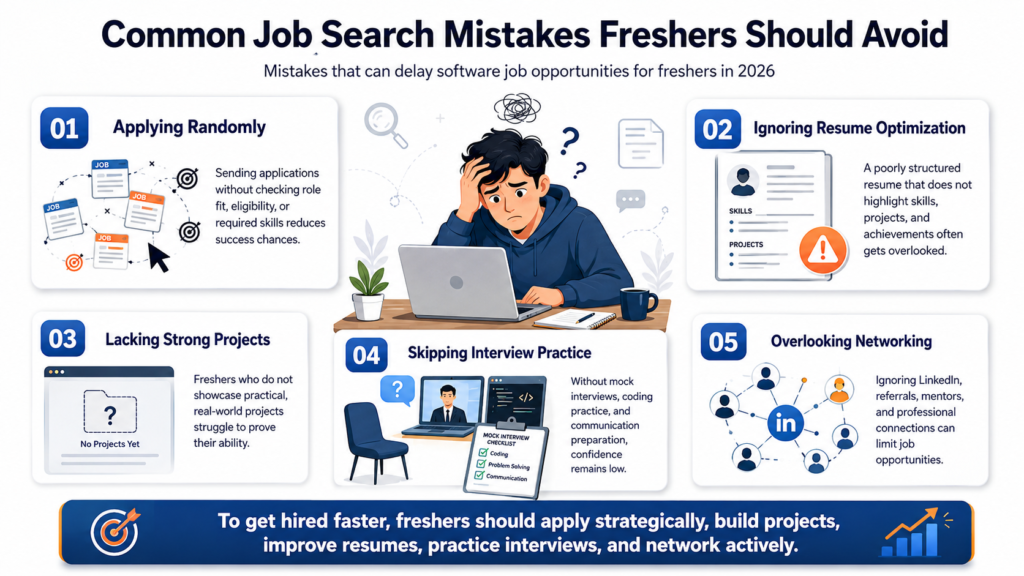
Submitting hundreds of applications without preparation rarely delivers results. Instead, target roles that match your skills, customize each application, and prepare thoroughly before applying.
Read the job description carefully, identify the required skills, and update your resume and portfolio accordingly.
A generic resume can reduce your chances of getting shortlisted. Tailor your resume for each role by highlighting relevant skills, projects, tools, and keywords from the job description.
You can also refer to Resume Tips 2026 to create an ATS-friendly resume that is clear, concise, and aligned with recruiter expectations.
Employers prefer candidates who can demonstrate practical skills through real-world applications. Build two or three meaningful projects and showcase them on GitHub to strengthen your portfolio.
Your projects should include proper documentation, clean code, clear features, and, wherever possible, deployment links.
Strong technical knowledge is not enough if you struggle during coding interviews. Practice coding problems, revise core concepts, and participate in mock interviews regularly.
This helps improve your speed, confidence, logical thinking, and ability to explain your solution clearly.
Many freshers rely only on job portals while overlooking the value of networking. Connecting with professionals on LinkedIn, attending tech events, joining developer communities, and seeking referrals can help you discover opportunities that may not always be publicly advertised.
If you are wondering how to get a software job as a fresher, focus on building the right skills, gaining practical experience, and preparing with a clear plan.
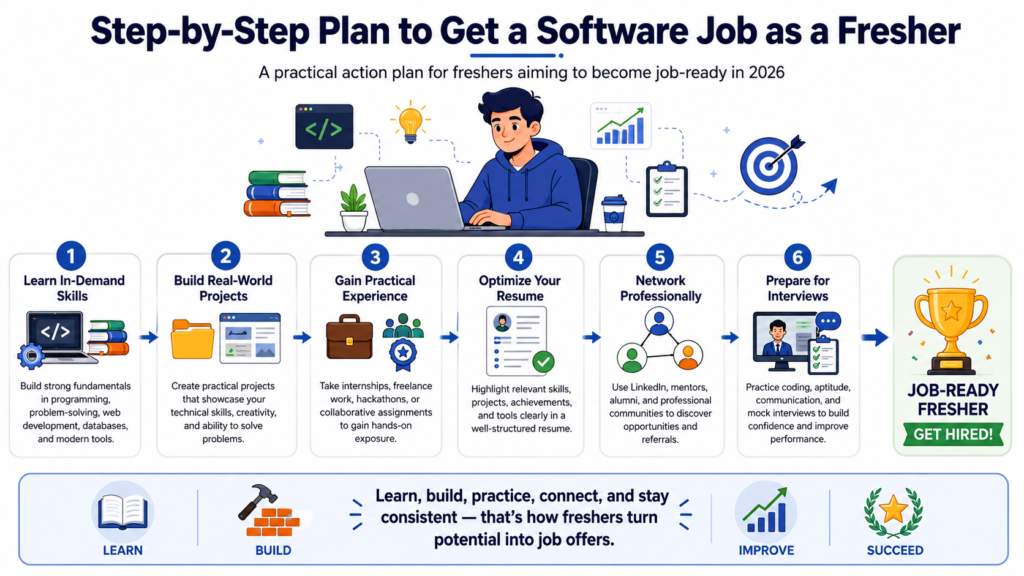
Prioritize technologies that employers actively hire for. Build a strong foundation in:
Learning these skills step by step will help you become more confident and job-ready.
Create projects that solve real problems instead of relying only on tutorial-based applications. Showcase your work on GitHub to demonstrate your technical skills.
Good projects should include clear functionality, clean code, database integration, API usage, and proper documentation.
Internships, freelancing, hackathons, and open-source contributions help you apply your knowledge and strengthen your resume before your first full-time job.
Even small practical experiences can help you understand deadlines, teamwork, code quality, debugging, and real-world development expectations.
Practice coding regularly, revise core concepts, and participate in mock interviews. Strong communication and problem-solving skills can make a significant difference during interviews.
Prepare for common topics such as programming fundamentals, data structures, algorithms, databases, APIs, OOPs, Git, and project-based questions.
Become job-ready with Gradious interview preparation resources and industry-focused programs.
Yes. Software engineering remains a promising career in 2026, but the path has become more skill-driven and competitive. AI is changing how developers work, but it is also creating demand for professionals with strong programming fundamentals, practical experience, and the ability to use modern tools effectively.
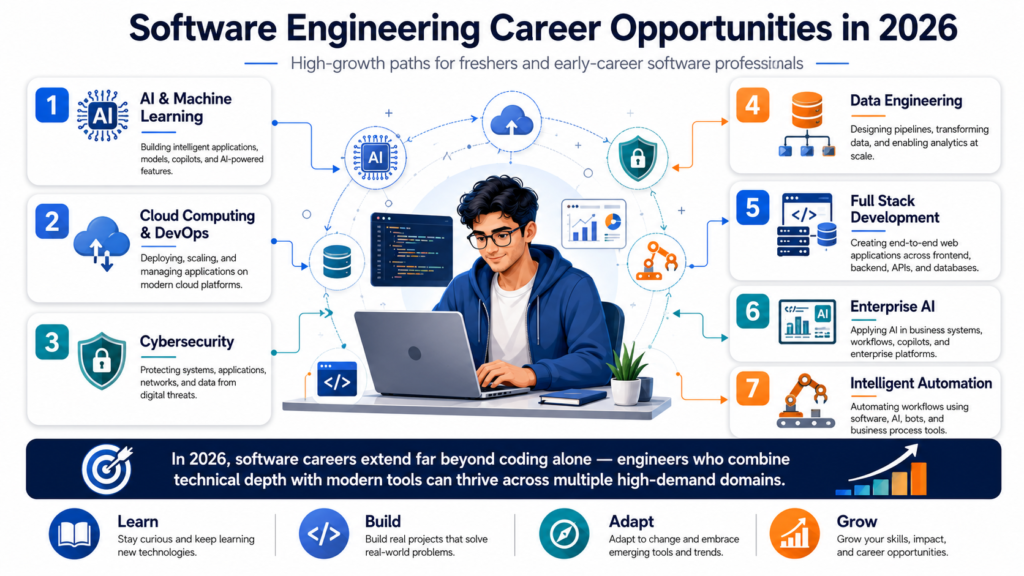
Emerging fields such as Artificial Intelligence, Cloud Computing, Cybersecurity, Data Engineering, Full Stack Development, Enterprise AI, and Intelligent Automation continue to create opportunities for skilled professionals.
Freshers who continuously upskill, build hands-on projects, and prepare strategically for interviews will be better positioned for long-term success in the software industry.
The reason freshers are struggling to get software jobs in 2026 is not simply a lack of opportunities. The bigger challenge is the growing gap between academic learning and industry expectations. Employers are looking for candidates with practical skills, real-world project experience, communication ability, and adaptability to evolving technologies.
By building a strong technical foundation, creating a solid project portfolio, optimizing your resume, networking strategically, and preparing seriously for interviews, you can significantly improve your chances of landing your first software role.
Remember, your degree may open the door, but your skills, projects, problem-solving ability, and commitment to continuous learning will help you build a successful career in software development.
Struggling to start your software career?
Learn industry-relevant technologies, work on real-world projects, strengthen your portfolio, and prepare confidently for technical interviews with Gradious.