
Currently, career transitions from non-tech to tech have accelerated at an unprecedented pace. Professionals across industries are re-evaluating their career paths, driven by evolving market demands, digital transformation, and the promise of higher growth opportunities.
At the same time, the tech industry continues to expand rapidly, creating a strong demand for skilled professionals. However, contrary to popular belief, you don’t always need a technical degree to enter this space. In fact, many individuals are successfully transitioning by leveraging their existing skills and complementing them with targeted learning.
So, whether you are exploring new career opportunities, seeking better compensation, or aiming for long-term stability, the shift to tech offers a compelling pathway.
In this blog, we will explore why professionals are making this switch, share real-life success stories, and provide a clear roadmap to help you get started.
To begin with, let’s first understand what a non-tech-to-tech career switch really means.
A non-tech-to-tech career switch refers to transitioning from a non-technical background, such as marketing, HR, teaching, or sales, into tech roles like data analyst, software developer, UX designer, or cloud engineer.
With structured learning and the right tools, professionals can make this shift within 3–6 months. More importantly, transferable skills combined with practical upskilling make this transition not only possible but highly achievable.
1) Who can switch? Anyone with basic problem-solving and learning ability
2) Best roles: Data Analyst, QA Tester, UX Designer, Cloud Engineer
3) Skills needed: Excel, SQL, Python, Testing Tools, Design Tools
4) Time required: 3–6 months (with consistent effort)
5) Salary potential: 30–100% increase depending on role
Organizations across industries are digitizing operations, which naturally increases the need for skilled talent. As a result, roles such as data analysts, cloud engineers, and developers are not only abundant but also highly compensated.
Moreover, many of these roles offer global opportunities, allowing professionals to work with international teams and clients.
Unlike traditional career paths, transitioning into tech no longer requires a full-time degree. Instead, professionals can leverage online courses, bootcamps, and certification programs to build relevant skills.
Additionally, self-paced learning makes it easier for working professionals to upskill without disrupting their current responsibilities.
Equally important, the tech industry offers strong long-term growth. As technologies evolve, professionals can continuously upgrade their skills and move into advanced roles such as AI specialists, data scientists, or solution architects.
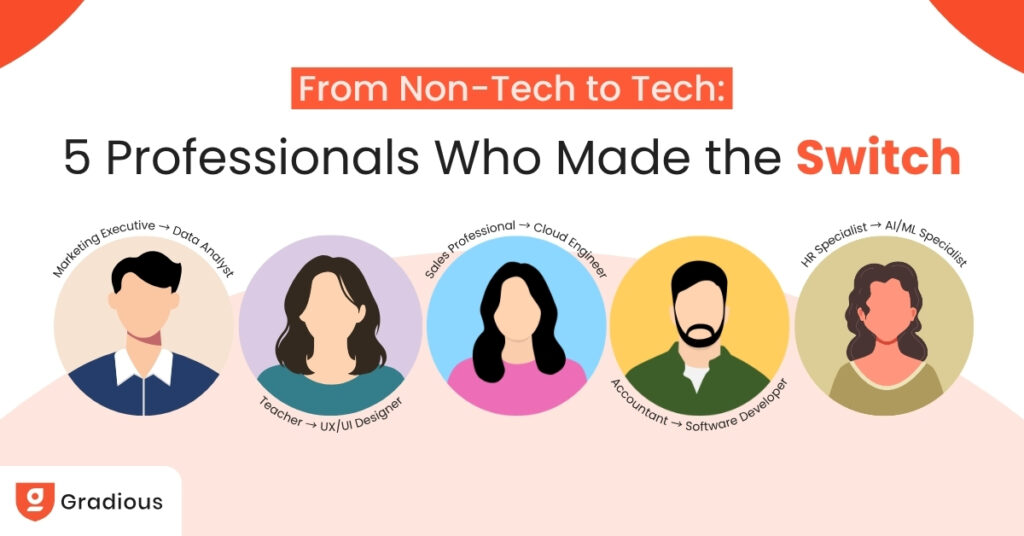
Real-world examples not only inspire but also make the transition feel achievable. In fact, these stories demonstrate that with the right mindset, structured learning, and consistency, professionals from any background can successfully move into tech roles.
Rahul started his career as a marketing executive, where he focused on campaign planning, customer segmentation, and performance tracking. Over time, he noticed that data was becoming the backbone of marketing decisions. However, he lacked the technical expertise to fully leverage it.
Recognizing this gap, Rahul started learning Excel for data handling, followed by SQL for querying databases. He then moved on to data visualization tools like Power BI to present insights effectively. Initially, balancing work and learning was challenging, but he dedicated a few hours daily to consistent practice.
Within six months, Rahul built multiple projects, including campaign performance dashboards and customer behavior analysis reports. These projects became a strong addition to his portfolio.
Eventually, he secured a data analyst role where he now works closely with marketing and product teams to drive data-backed strategies.
Key takeaway: If you are already working with data in any capacity, formalizing your analytical skills can significantly accelerate your transition into tech.
Anjali spent several years as a school teacher, where she developed strong communication, empathy, and problem-solving skills. While exploring new career options, she came across UX/UI design and realized that understanding user behavior is at the core of both teaching and design.
She began by learning design fundamentals, including user research, wireframing, and prototyping. Tools like Figma and Adobe XD helped her translate ideas into visual interfaces. Additionally, she studied design thinking principles to better understand user-centric problem-solving.
To gain practical experience, Anjali worked on mock projects such as redesigning educational apps and improving user flows for learning platforms. She also sought feedback from design communities, which helped refine her work.
After building a strong portfolio, she transitioned into a UX designer role at a digital product company.
Key takeaway: Careers that involve understanding people, like teaching, provide a strong foundation for UX roles.
Arjun, an accountant by profession, had minimal exposure to programming. However, his daily work involved handling financial data, identifying discrepancies, and applying logical reasoning skills that are highly relevant in software development.
Motivated to explore new opportunities, Arjun started learning Python through beginner-friendly resources. Initially, coding concepts felt overwhelming, but he persisted by practicing small programs daily.
Gradually, he progressed to web development, learning HTML, CSS, and JavaScript. He built simple applications such as expense trackers and financial calculators, which aligned with his domain expertise.
Over time, these projects demonstrated both his technical skills and domain knowledge. With consistent effort and portfolio building, Arjun secured a role as a junior software developer.
Key takeaway: Logical thinking and problem-solving skills can make learning programming significantly easier.
Meena worked in sales, where she regularly interacted with CRM platforms and cloud-based tools. While she wasn’t directly involved in technical implementation, her curiosity about how these systems functioned sparked her interest in cloud computing.
She began her journey by learning the fundamentals of cloud platforms such as AWS and Azure. Certifications played a key role in validating her knowledge, while hands-on labs helped her understand real-world applications.
Despite having no prior technical background, her familiarity with business processes gave her an advantage in understanding how cloud solutions support organizations.
After completing certifications and working on practical projects, Meena transitioned into a cloud engineering role. Today, she works on deploying and managing scalable cloud infrastructure.
Key takeaway: Exposure to technology in non-tech roles can serve as a stepping stone into specialized tech careers.
Kiran’s background in HR involved managing employee data, performance metrics, and workforce analytics. Over time, he realized that advanced data analysis and predictive insights could significantly improve HR decision-making.
Driven by this realization, Kiran started learning Python and statistics, followed by machine learning concepts. Tools like Tensor Flow and libraries such as Pandas and Scikit-learn became part of his learning journey.
He applied his HR knowledge to build predictive models, such as employee attrition analysis and performance forecasting. These domain-specific projects helped him stand out.
Eventually, Kiran transitioned into an AI/ML role, where he now works on building intelligent systems that enhance organizational efficiency.
Key takeaway: Combining domain expertise with advanced tech skills can create highly specialized and in-demand career paths.
One of the biggest misconceptions about switching to tech is that you need to start from scratch. In reality, many of your existing skills are highly valuable.
Therefore, instead of focusing on what you lack, it is more effective to build on what you already have.
1) Choose the Right Role
Firstly, identify a role that aligns with your interests and strengths. For instance, if you enjoy working with data, consider data analytics. If you lean towards creativity, UX design could be a more suitable choice.
2) Learn Core Skills
Next, focus on acquiring essential tools and technologies. This may include:
3) Build Real-World Projects
Also, practical experience plays a crucial role. Employers value hands-on skills, so working on projects helps demonstrate your capabilities.
4) Create a Strong Portfolio
Subsequently, compile your projects into a portfolio. This showcases your skills and significantly improves your chances of getting shortlisted.
5) Apply Strategically
Finally, focus on targeted job applications. Tailor your resume, leverage LinkedIn, and actively network with professionals in your desired field.
| Best Tech Roles for Non-Tech Professionals | |||
| Role | Key skills | Difficulty level | Salary potential |
| Data Analyst | Excel, SQL, Data Visualization | Moderate | High |
| QA Tester | Testing Tools, Communication | Easy to Moderate | Moderate |
| UX Designer | Figma, User Research, Design Thinking | Moderate | High |
| Cloud Engineer | AWS, Azure, Networking | Moderate to High | Very high |
| AI/ML Specialist | Python, Machine Learning | High | Very high |
While a non-tech to tech career switch is highly achievable, it is not without its challenges. However, the key is not to avoid these obstacles but to understand and navigate them strategically.
Below are some of the most common challenges professionals face, along with practical ways to overcome them.
1) Fear of Technology
One of the biggest barriers is the assumption that tech is too complex or only meant for individuals with a coding background. This fear often prevents professionals from even taking the first step.
How to overcome it:
2) Lack of Clear Direction
Many professionals struggle with where to begin. With so many roles – data analytics, development, cloud, and AI it can feel overwhelming to choose the right path.
How to overcome it:
3) Balancing Learning with a Full-Time Job
For working professionals, finding time to upskill can be challenging. As a result, delays and inconsistencies often affect learning.
How to overcome it:
4) Lack of Practical Experience
Another common challenge is the lack of hands-on experience. Many candidates complete courses but struggle to demonstrate their skills in real-world scenarios.
How to overcome it:
5) Imposter Syndrome and Self-Doubt
It’s quite natural to feel like you’re not “ready enough,” especially when transitioning into a new field. Many professionals compare themselves to experienced candidates and lose confidence.
How to overcome it:
6) Competitive Job Market
The tech industry is competitive, and many candidates are applying for similar roles. This can make it difficult to stand out.
How to overcome it:
Transitioning from a non-tech to a tech career is no longer an exception; it’s becoming the norm. As we have seen, professionals from diverse backgrounds are successfully making this shift by leveraging their existing skills and committing to continuous learning.
More importantly, the journey doesn’t require perfection; it requires consistency. With the right approach, tools, and mindset, you can build a rewarding career in tech.
Ready to make the switch from non-tech to tech?
If you are serious about transitioning into tech, the right guidance can make all the difference. Structured learning, real-world projects, and expert mentorship can significantly accelerate your journey.
Start your tech career today with Gradious industry-focused training programs designed for career switchers.
Yes, with the right learning path and dedication, anyone can transition into tech roles.
Skills like Excel, SQL, and basic testing are relatively easier to start with.
Typically, it takes 3–6 months with consistent effort.
Yes, especially when combined with hands-on projects and mentorship.
Absolutely. Many tech roles offer competitive salaries and growth opportunities.