

Future-Ready Workforce Training Imagine this, your latest dream project is suddenly put on hold. This is not due to lack of funding or vision, but rather your team lacks the essential skills to deliver it. Deadlines slip, clients grow impatient, and competitors move faster. This is the reality many IT leaders face today.
The rapid rise of AI, cloud platforms, and data-driven systems has created a widening gap between what businesses demand and what employees can deliver. Traditional hiring alone cannot close this gap. It is quite expensive, slow, and rarely produces talent that is productive from day one.
That is why Future-Ready Workforce Training is a game changer. IT companies can transform their existing employees into agile, adaptable, and innovation-ready via structured & outcome-driven training programs. Gradious helps organizations bridge the skill gaps with industry-optimized corporate training programs. Through this approach IT leaders can accelerate organizations’ productivity and build teams that thrive in the digital era.
The IT industry relies on speed, innovation, and precision. Yet technical competence alone no longer guarantees success. Clients now demand faster delivery, seamless integration, and solutions that predict potential challenges. In order to meet these demands, IT leaders must build future-ready teams that are not just skilled but also adaptable, collaborative, and aligned with business outcomes.
Adaptability: Future-ready teams adapt quickly when technologies or project requirements change. They don’t stall when a new framework emerges or a client shifts priorities; instead they adapt and keep going.
Continuous Learning: These teams embrace learning as an integral part of their culture. Employees actively seek new knowledge, experiment with tools, and apply skills to real projects.
Cross-Functional Skills: Future-ready teams break silos. Developers understand analytics, data engineers grasp business logic, and project managers speak the language of technology. This blend of skills drives innovation and efficiency.
These qualities don’t develop by chance. They require deliberate investment in tech talent development and corporate upskilling programs that align employee growth with organizational goals.
AI, Cloud Computing, and Data Science are no longer optional; they are the core pillars of today’s IT and digital transformation strategies. Every client now demands some level of automation, data intelligence, or scalable cloud-native infrastructure.
As these technologies evolve, client expectations grow at the same pace. Without structured and continuous learning, teams quickly fall behind, making it harder for companies to stay competitive. An organization that cannot deliver AI-driven solutions or cloud-native deployments risks losing high-value projects to competitors who can.
Continuous upskilling keeps employees relevant, productive, and future-ready. It empowers teams with the latest tools, frameworks, and best practices, while also fostering a strong learning culture. Employees who see clear opportunities for growth feel more motivated, loyal, and capable of delivering high-quality work. Companies that do not prioritize skill development often face stagnation, low morale, and higher turnover.
Many IT leaders try to bridge skill gaps by hiring new talent. While it may seem like a quick fix, this approach is expensive, time-consuming, and inefficient. Recruitment cycles can take months, onboarding drains resources, and new employees still need time to ramp up before they contribute effectively. During this period, project timelines slip, and client satisfaction declines.
In contrast, upskilling existing employees is faster, less expensive, and more sustainable. It strengthens loyalty and ensures teams are aligned with the company’s long-term vision. By building skills from within, organizations develop a workforce that grows with the business and consistently delivers exceptional results, rather than relying on external hiring.
Many IT leaders understand the urgency for workforce development but often struggle to implement strategies that deliver practical and measurable results. The most common obstacles include:
Skill Gaps
New hires often have theoretical knowledge but lack hands-on experience. This slows delivery, increases reliance on senior staff, and creates project bottlenecks.
High Recruitment & Onboarding Costs
Hiring to fill skill gaps is expensive and slow. Long recruitment cycles, intensive onboarding, and delayed productivity impact timelines and client satisfaction.
Retention Challenges
Employees expect continuous learning. Without growth opportunities, they leave. resulting in high turnover, loss of institutional knowledge, and repeated rehiring efforts.
Rapid Technology Evolution
Tech evolves faster than traditional training models. Static programs cannot keep employees aligned with new tools, frameworks, and best practices, leading to outdated skills and reduced competitiveness.
Limitations of Traditional Training
Conventional training focuses on theory, not real-world application. Teams struggle to apply what they learn, causing stalled projects, lower productivity, and reduced confidence.
Today’s IT challenges demand more than generic training or one-time workshops. Companies need targeted, outcome-driven learning programs that close skill gaps, boost productivity, and align employee growth with business goals. This is where Gradious creates real difference.
Gradious Bootcamps
High-intensity, hands-on programs that build job-ready skills from day one. These bootcamps emphasize real-world application: coding, cloud deployment, data engineering, DevOps, AI/ML, GenAI and more.
Corporate Upskilling/reskilling Programs
Fully customized training pathways designed around your business objectives, tech stack, and project timelines. Whether the focus is faster delivery, stronger client engagement, or adopting new technologies, Gradious tailors programs that directly drive business outcomes.
Gradious LMS Solutions
A comprehensive talent development suite: Screen, Interview, Upskill, and Labs that includes everything from recruiting to evaluation to continual learning. This integrated approach helps companies identify, onboard, and develop talent efficiently.
Real-World, project-based Learning
Training based on genuine industrial circumstances guarantees that skills are practical and instantly relevant.
Hands-On Mentorship
Expert trainers give ongoing support, assisting staff in overcoming obstacles and building confidence.
Continuous Skill Evaluation
Regular assessments track progress, highlight gaps, and ensure accountability throughout the learning process.
Always Updated With the Latest Tools
Programs evolve alongside emerging technologies, keeping teams competitive and future-ready.
Develop Practical and Job-Ready Skills
Employees gain practical, hands-on skills that directly enhance performance. Instead of theory-heavy training, Gradious focuses on applying tools, frameworks, and modern technologies in live project scenarios.
Faster, More Effective Onboarding
New hires and reskilled employees reach full productivity quickly thanks to structured, outcome-driven training. This shortens ramp-up time, accelerates project execution, and reduces the time leaders spend closing skill gaps.
Alignment with the Latest Industry Trends
With continuously updated curricula, Gradious ensures teams stay current with emerging tools, frameworks, and best practices. This keeps organizations competitive in fast-evolving tech landscapes where innovation speed matters.
Reduced Hiring and Training Costs
Upskilling existing employees is far more cost-efficient than relying on constant recruitment. Companies save on hiring cycles, onboarding expenses, and productivity delays.
Improved Project Delivery and Quality
Teams trained with the right skills deliver projects faster, more accurately, and with greater confidence. This leads to higher client satisfaction, smoother execution, fewer errors, and more repeat business.
Higher Employee Engagement and Retention
Clear learning and growth opportunities boost motivation, loyalty, and job satisfaction. Gradious fosters a culture of continuous development, reducing turnover and strengthening the company’s reputation as an employer of choice.
Flexible & Scalable Training Solutions
Gradious programs can scale for startups, mid-sized companies, and large enterprises. Whether upskilling a small team or large workforce, training is tailored to fit industry needs and strategic objectives.
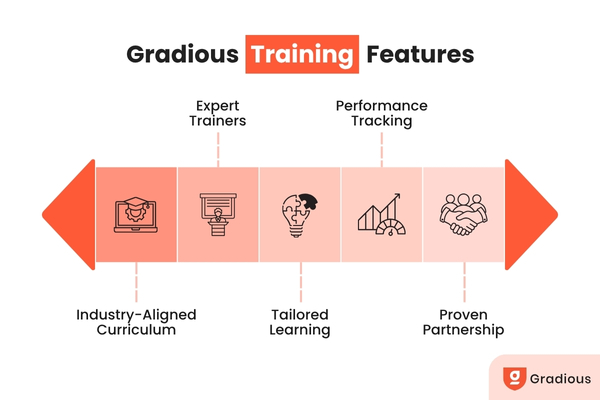
Gradious follows a proven and structured approach that helps IT leaders achieve measurable, long-term results. The process includes four essential steps:
Assess Skill Gaps
Start by identifying exactly where teams need development. Gradious maps current employee capabilities against project demands and industry standards. This detailed assessment reveals gaps in coding, cloud deployment, automation, data analytics, or infrastructure management, ensuring leaders invest in the right areas instead of generic training.
Choose the Right Program
Leaders can select the most effective training path: bootcamps, corporate upskilling programs, or fully customized learning journeys. Each program is aligned with business goals such as faster project delivery, stronger client outcomes, or adoption of new technologies.
Deploy Training Modules
Gradious blends theory, hands-on practice, and expert mentorship. Employees learn through real-world projects, labs, and simulations that mirror actual business challenges. Continuous guidance from industry trainers ensures skills are understood, applied, and retained, accelerating team readiness and confidence.
Measure and Optimize Outcomes
Training success is tracked through built-in analytics and feedback loops. Leaders get clear visibility into improvements in onboarding speed, delivery quality, productivity, and employee engagement. These insights enable continuous program optimization to match with the changing business needs.
The future of work is already unfolding and the companies that invest in workforce development will be the ones that lead it. Future-ready training isn’t just about keeping pace with technology; it is about building teams that fuel innovation, resilience, and sustained business growth.
Gradious empowers organizations to turn their workforce into a competitive advantage. Through specialized bootcamps, tailored upskilling programs, and end-to-end learning solutions, Gradious delivers the skills, structure, and outcomes modern IT environments require.
Take the next step.
Schedule a consultation with Gradious today and start building high-performing and future-ready teams.