
Engineering graduates may score well in a programming exam, yet still struggle to solve real-world problems.
They may understand algorithms in theory but hesitate when asked to write code from scratch. They may complete academic projects but struggle to explain their decisions in an interview. When campus placements begin, colleges often discover the same challenge: academic performance does not always translate into job readiness.
This gap between what students learn and what employers expect is becoming increasingly important for colleges to address. Building job-ready students requires more than classroom teaching or last-minute placement training. Students need structured opportunities to learn relevant technologies, practise their skills, work on projects, receive feedback, and prepare for real hiring processes.
That is where industry-oriented training can make a difference.
Keep reading to explore how Gradious helps colleges develop technical and industry-relevant skills by integrating training, practice, assessment, and placement preparation into the academic journey.
Classroom education gives students the technical foundation they need. However, employment requires them to apply that knowledge in practical situations.
A recruiter may not ask a student to simply define a data structure or programming concept. Instead, the student may be expected to:
Simply put, knowing programming concepts is different from knowing how to solve problems with code.
Students develop this ability through consistent practice, practical exposure, and continuous evaluation. The missing link is not necessarily more theory. It is a structured path from learning to application.
The World Economic Forum’s Future of Jobs Report 2025 highlights that skills such as analytical thinking, AI and big data, technological literacy, resilience, flexibility, and lifelong learning are becoming increasingly important as employers prepare for changing workforce requirements. World Economic Forum
Job readiness is a blend of technical, practical, and professional capabilities. For engineering students, this means building strong fundamentals while also learning how to apply those skills in assessments, projects, interviews, and real-world work environments.
Students need strong fundamentals in programming, data structures, algorithms, databases, and technologies relevant to their target roles.
Employers value students who can approach unfamiliar problems logically rather than rely only on memorized solutions.
Regular coding practice helps students turn concepts into executable solutions. It also exposes gaps that may not appear during conventional classroom learning.
Real-world projects allow students to combine multiple skills and demonstrate that they can build something beyond a standard academic exercise.
Students must be able to explain their approach, discuss their projects, and communicate technical ideas clearly.
Campus recruitment often includes aptitude tests, coding assessments, technical interviews, and HR discussions. Students need hands-on practice in these stages before encountering them in the actual recruitment process.
Together, these capabilities form the foundation of student employability skills and help colleges develop more industry-ready graduates.
Colleges need a structured approach to build and assess student skills throughout the academic journey, rather than depending only on one-off workshops before placement season.
Gradious supports this through industry-aligned training programs and the LEAP LMS platform for learning, practice, evaluation, and placement preparation. LEAP brings learning, practical labs, coding challenges, assessments, interviews, and analytics into an integrated environment designed to support engineering students and colleges.
Students need to acquire skills that are relevant to the roles they are preparing for. Gradious helps colleges align training with industry expectations through structured learning paths and curriculum-aligned programs.
The LEAP LMS platform supports both learning and evaluation, allowing colleges to connect training with measurable outcomes.
This makes college placement training more purposeful. Instead of treating placement preparation as a separate activity, colleges can integrate skill development into the broader student journey.
Explore Gradious college placement training at: https://gradious.com/colleges/
Theoretical knowledge becomes valuable when students can apply it. Gradious provides practice-focused labs, coding challenges, and coding environments that allow students to work on problems rather than simply consume course content.
LEAP LMS also supports auto-evaluation across multiple programming languages, including Java, JavaScript, Python, C, and C++.
This creates a continuous cycle:
Learn → Practice → Apply → Evaluate → Improve
This continuous learning cycle helps students build industry-ready skills with greater confidence.
Technical preparation is only one part of campus placement readiness. Students also need experience with assessments, interviews, communication, and role-specific preparation.
Gradious LEAP LMS supports mock testing, AI-powered video interviews, online assessments, and detailed performance analytics.
As a result, students can identify gaps before facing an actual recruiter, and colleges can support them with more targeted preparation.
Explore more about Gradious placement preparation at: https://gradious.com/leap-lms-platform/
Becoming job-ready is a progression, not a single training event. Gradious follows this approach through seven structured stages:
Learn → Practice → Build → Assess → Improve → Interview → Get Ready
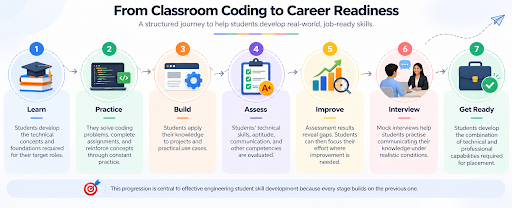
Learn: Students develop the technical concepts and foundations required for their target roles.
Practice: They solve coding problems, complete assignments, and reinforce concepts through consistent practice.
Build: Students apply their knowledge to projects and practical use cases.
Assess: Students’ technical skills, aptitude, communication, and other competencies are evaluated.
Improve: Assessment results reveal gaps, allowing students to focus their effort where improvement is needed.
Interview: Mock interviews help students practise communicating their knowledge under realistic conditions.
Get Ready: Students develop the combination of technical and professional capabilities required for placement.
This progression is central to effective engineering student skill development because every stage builds on the previous one.
Colleges need measurable indicators that show where students are performing well and where additional support is required.
These indicators can include:
Gradious LEAP provides analytics and reporting capabilities that help colleges track student performance and make data-driven decisions. Its assessment environment supports multiple question formats, coding evaluation, mock testing, and AI-powered assessment capabilities.
This gives colleges a clearer view of placement readiness.
Instead of asking, “Are our students ready?”, institutions can ask more useful questions:
Learn more about student assessments and placement preparation at: https://gradious.com/lms-for-placement-preparation/
Placement preparation should not begin only when recruiters arrive on campus. By that stage, students may have limited time to address fundamental skill gaps.
A stronger model starts earlier and develops capabilities progressively. Colleges can introduce technical foundations first, strengthen coding and problem-solving through practice, include projects and assessments, and then gradually move students toward interview simulations and placement preparation.
This approach also makes industry-oriented training for colleges more sustainable. Rather than compressing everything into a few months, institutions can build employability into the student’s academic journey.
The objective is simple: students should be developing placement readiness before they need to demonstrate it.
A degree shows what a student has studied, but job readiness demonstrates what that student can actually do. For colleges, the goal should be to connect classroom education with continuous practice, practical application, measurable assessment, and placement preparation.
The journey is straightforward:
Classroom Learning → Practical Skills → Industry Exposure → Assessment → Improvement → Interview Preparation → Placement Readiness
Gradious helps colleges build this journey through industry-aligned training and an integrated learning and evaluation ecosystem designed to help students develop the skills required for the workplace.
Ready to build a stronger pipeline of job-ready students?
Explore Gradious Programs for Colleges at: https://gradious.com/colleges/