
Colleges today are not only expected to provide quality education; they are also expected to help students become job-ready. While most institutions have adopted Learning Management Systems, or LMS platforms, to manage courses, assignments, assessments, attendance, and learning resources, an LMS alone cannot manage the complete journey from student learning to successful placement.
This is where a placement operating system for colleges becomes important. It connects student skills, training progress, placement teams, recruiters, assessments, interviews, and hiring outcomes in one centralized system.
As hiring becomes increasingly skills-focused and technology-driven, colleges need tools that go beyond academic learning. They need a platform that helps them understand whether students are actually prepared for the workplace, where skill gaps exist, and how effectively training is converting into career outcomes.
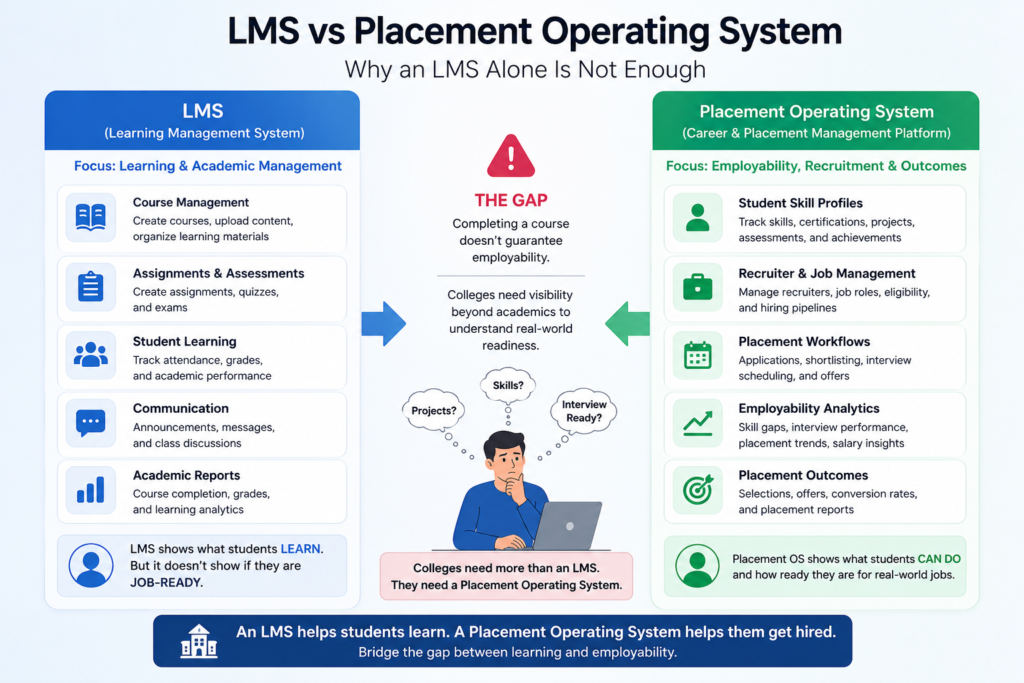
An LMS is primarily designed to support teaching and learning. Faculty members can upload course materials, conduct assessments, assign projects, track attendance, and communicate with students.
However, placement management involves a very different set of activities.
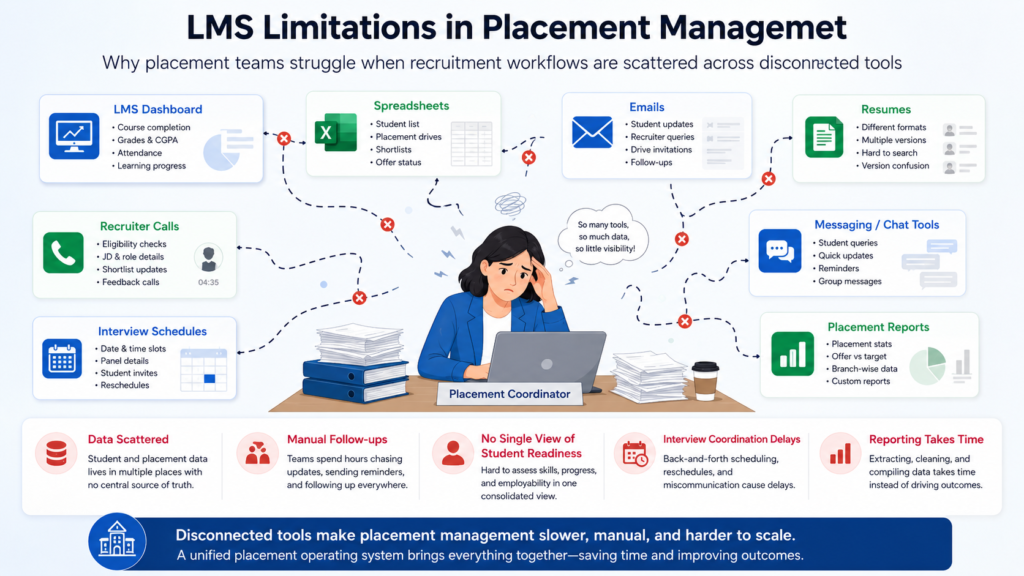
Placement teams need to identify which students are job-ready, track technical and soft skills, manage recruiter relationships, schedule interviews, monitor applications, and report placement results. In many colleges, these activities are still handled through spreadsheets, emails, messaging groups, shared folders, and disconnected systems.
A college placement management system brings these activities together.
For example, knowing that a student completed a Python course does not necessarily mean the student is ready for a Python developer interview. The placement team also needs visibility into projects, certifications, assessment scores, communication skills, mock interview performance, and practical experience.
An LMS can show what a student has learned. A placement operating system helps institutions understand whether that learning is translating into employability.
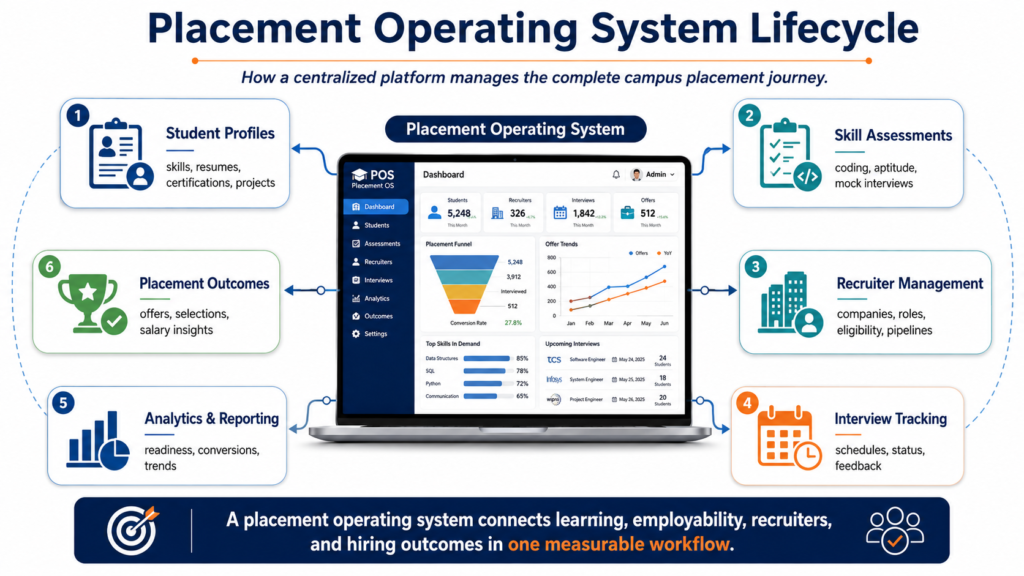
A placement operating system is a centralized technology platform designed to manage the complete campus placement lifecycle.
Instead of treating training and placement as separate activities, it connects them through student profiles, skill assessments, recruiter requirements, placement workflows, interview tracking, and analytics.
In simple terms, it helps colleges move from manual placement coordination to a more structured, measurable, and data-driven placement process.
A strong placement system should provide a detailed view of each student’s employability profile.
This can include:
This gives placement officers a clearer picture of student readiness and helps identify skill gaps before recruitment season begins.
Managing employer relationships is another important part of campus recruitment.
A placement operating system can maintain a centralized company database containing recruiter information, job roles, eligibility criteria, hiring history, interview schedules, communication records, and placement outcomes.
Instead of searching through old emails or spreadsheets, placement teams can quickly access recruiter information, track company engagement, and manage each employer’s hiring pipeline in one place.
Placement teams need more than a final placement percentage. They need to understand what is working, where students are struggling, and which interventions are improving outcomes.
A centralized system can help track:
These insights can help institutions make better decisions about training programs, industry partnerships, student support, and placement strategy.
The need for verified skills and continuous workforce development is becoming more important as employers prepare for changing skill requirements. The World Economic Forum’s Future of Jobs Report 2025 highlights that analytical thinking remains a key core skill, while AI and big data, networks and cybersecurity, and technological literacy are among the fastest-growing skills. (World Economic Forum)
An LMS and a placement operating system are not competing technologies. They solve different problems and can work together.
| Area | LMS | Placement Operating System |
| Primary purpose | Learning management | Career and placement management |
| Course delivery | Yes | Can integrate training data |
| Assignments | Yes | Limited or connected through integrations |
| Skill tracking | Basic | Detailed employability profiles |
| Recruiter management | Usually limited | Core functionality |
| Interview scheduling | Limited | Built into placement workflows |
| Placement analytics | Basic academic reports | Recruitment and outcome analytics |
| Student readiness | Indirectly monitored | Directly monitored |
| Hiring pipeline | Not designed for it | Central feature |
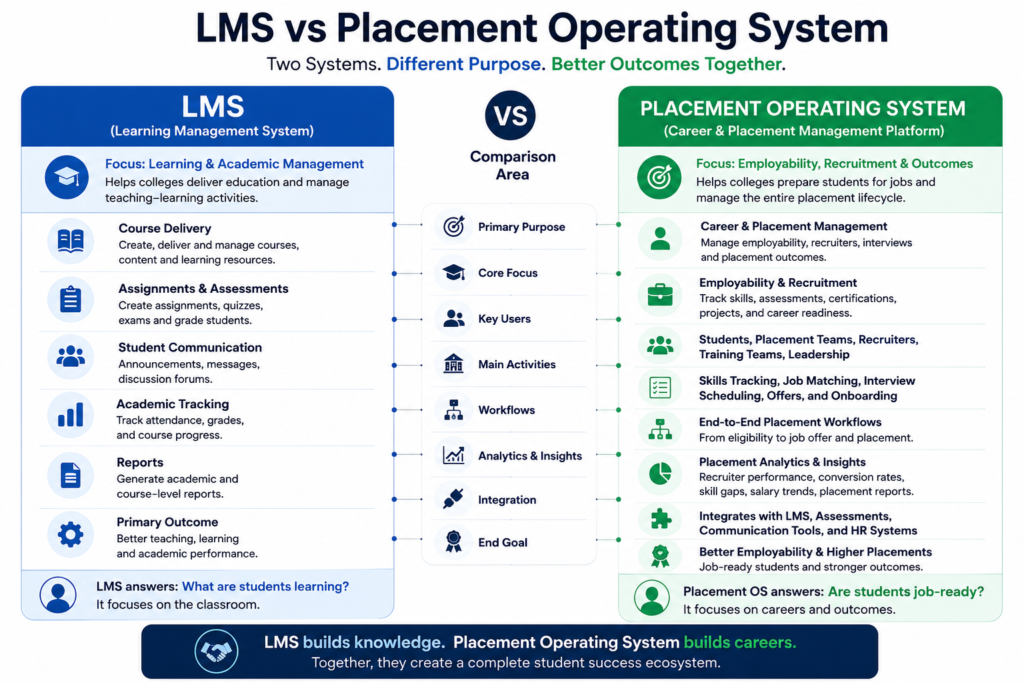
A campus placement software solution is therefore designed around the specific needs of students, placement officers, training teams, and recruiters. It helps colleges connect learning data with employability outcomes.
The campus recruitment process is becoming more competitive and skills-focused. Companies increasingly want candidates who can demonstrate practical ability, not just academic qualifications.
A placement operating system helps colleges prepare students earlier, manage recruiter expectations better, and make placement decisions using reliable data instead of scattered information.
Institutions can continuously monitor student readiness instead of starting placement preparation only a few months before recruitment.
Students can receive targeted training based on their skill gaps, while placement teams can identify students who need additional support.
Colleges can also guide students through a structured Step-by-Step Roadmap for Tech Careers so that learning is connected to actual career goals.
Recruiters want institutions that can provide candidates who meet specific job requirements.
With structured student skill data, colleges can share more relevant candidate profiles with employers and understand the skills companies are actually hiring for.
This can lead to stronger and more meaningful industry partnerships.
Manual placement management can consume significant time.
Teams may have to maintain spreadsheets, send eligibility lists, collect resumes, schedule interviews, update students, and prepare reports manually.
Placement automation reduces repetitive work by creating standardized workflows for eligibility checks, application tracking, interview scheduling, student communication, recruiter updates, and reporting.
Instead of relying on assumptions, placement teams can use real-time data to answer questions such as:
This makes placement management more measurable, strategic, and outcome-focused.
The right platform should support the entire student-to-employer journey.
A strong placement operating system should not be limited to interview scheduling or company records. It should help colleges track readiness, improve training alignment, manage recruiter relationships, and evaluate placement outcomes.
Every student should have a structured digital profile containing academic information, skills, certifications, projects, assessments, career interests, and readiness indicators.
This helps placement teams understand which students are suitable for specific job roles and where additional training is required.
Students should be able to maintain updated resumes and project portfolios that can be aligned with specific job opportunities.
For additional guidance, colleges can share resources such as Resume Tips That Will Get You Hired in 2026 with students.
Mock tests and interviews help students understand their current readiness.
Placement teams can use performance data to identify students who need additional practice in coding, problem-solving, communication, or role-specific preparation.
Recruiters should be able to share job requirements, review eligible candidates, schedule interviews, and provide hiring updates through a centralized interface.
This can reduce coordination gaps and make campus recruitment smoother for both colleges and employers.
Placement officers and institutional leadership need dashboards that provide a quick overview of recruitment activity, student readiness, company participation, interview progress, and final outcomes.
Dashboards make placement performance easier to monitor and communicate.
A well-designed student placement platform can benefit students, placement teams, recruiters, and institutional leadership.
It turns placement management from a short-term final-year activity into a continuous employability process.
Students get better visibility into their skills, career readiness, applications, interviews, and areas for improvement.
They can understand what roles they are ready for, what skills they need to strengthen, and how to prepare more effectively.
Placement officers can reduce manual work, organize recruiter information, automate workflows, and monitor recruitment activities from one platform.
This allows teams to spend more time on student guidance, employer engagement, and placement strategy.
Employers can access more structured candidate information and identify students who match their requirements.
This can improve candidate shortlisting and reduce unnecessary back-and-forth communication.
Management gets clearer data on placement performance, employer engagement, skill development, training effectiveness, and career outcomes.
The biggest advantage is that placement becomes an ongoing process rather than a short-term activity conducted only during the final year.
AI is changing how recruiters identify, screen, and evaluate candidates. Colleges therefore need to prepare students for hiring processes that increasingly use digital screening, AI-assisted evaluation, and skills-based shortlisting.
A placement operating system can help colleges respond to this shift by organizing student data, improving profile quality, supporting skill matching, and enabling better placement analytics.
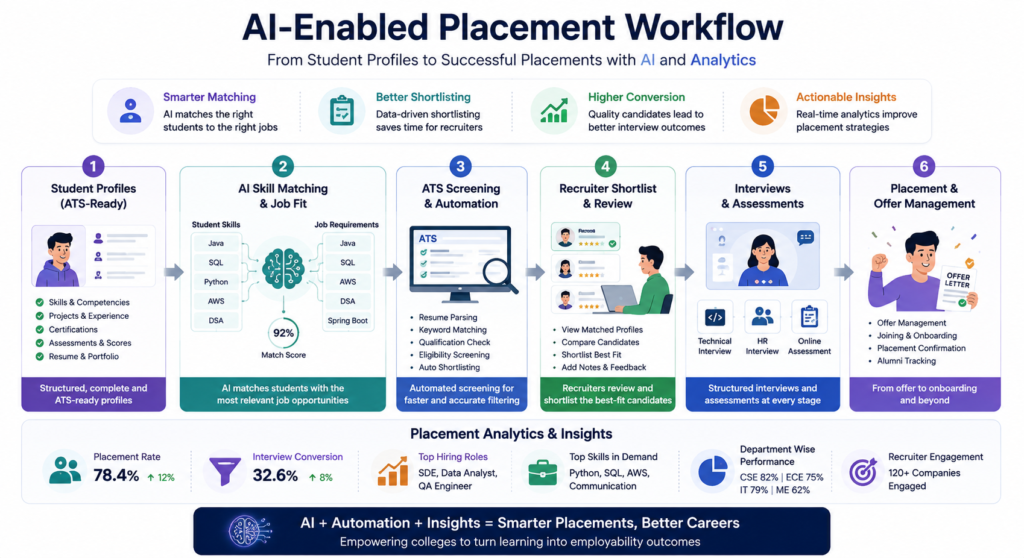
Students can maintain structured resumes and profiles that clearly highlight skills, projects, certifications, assessments, and experience.
This can make candidate information easier to evaluate during digital recruitment processes and Applicant Tracking System-based screening.
AI-powered matching can compare student skills with job requirements and help identify suitable opportunities.
For example, if a company is hiring for a Java developer with SQL and cloud exposure, the system can identify students whose profiles closely match those requirements.
This should support placement decisions, not replace human judgment. Placement teams and recruiters still need to evaluate context, communication, project quality, and role fit.
Recruitment data can help institutions understand which skills are in demand, which roles attract the most students, and where candidates are losing opportunities.
This becomes particularly useful when colleges use campus recruitment management technology to connect student readiness with employer requirements.
The U.S. Bureau of Labor Statistics projects that computer and information technology occupations will grow much faster than the average for all occupations from 2024 to 2034. This is useful global context for technology career demand, although colleges should interpret it alongside local hiring trends and recruiter feedback. (Bureau of Labor Statistics)
The future of campus placements is moving from academic management to career outcome management.
An institution may successfully deliver hundreds of courses, but that does not automatically mean students are prepared for employment.
A placement operating system helps connect the different parts of the student journey:
Learning → Skills → Assessment → Readiness → Employer Matching → Interviews → Placement
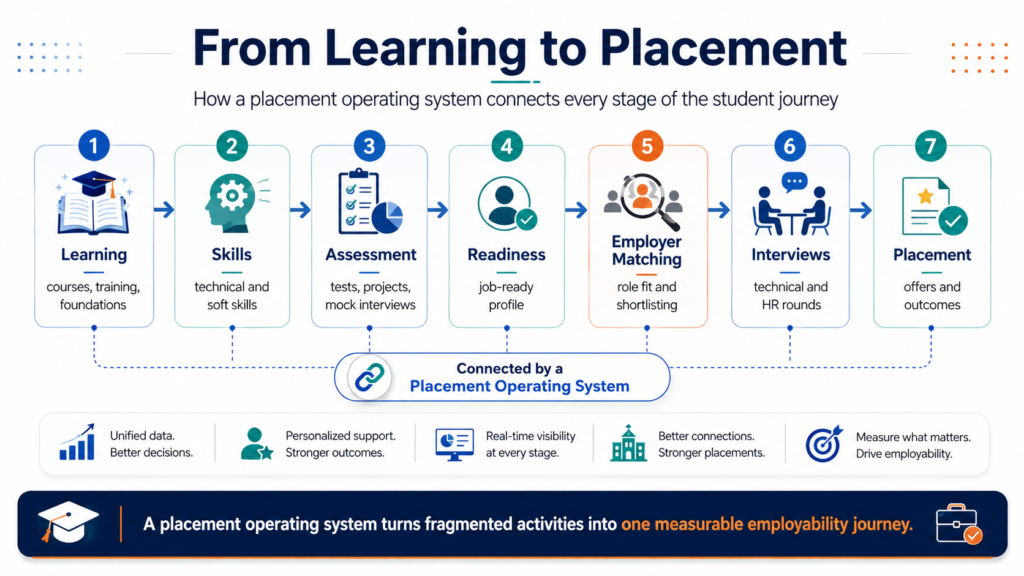
This approach also encourages colleges to think beyond placement numbers. The goal should be to develop students who can meet real industry requirements.
Building foundational technical skills remains an important part of this process. Colleges can encourage students to Learn Programming Basics and gradually progress toward more specialized, industry-relevant skills.
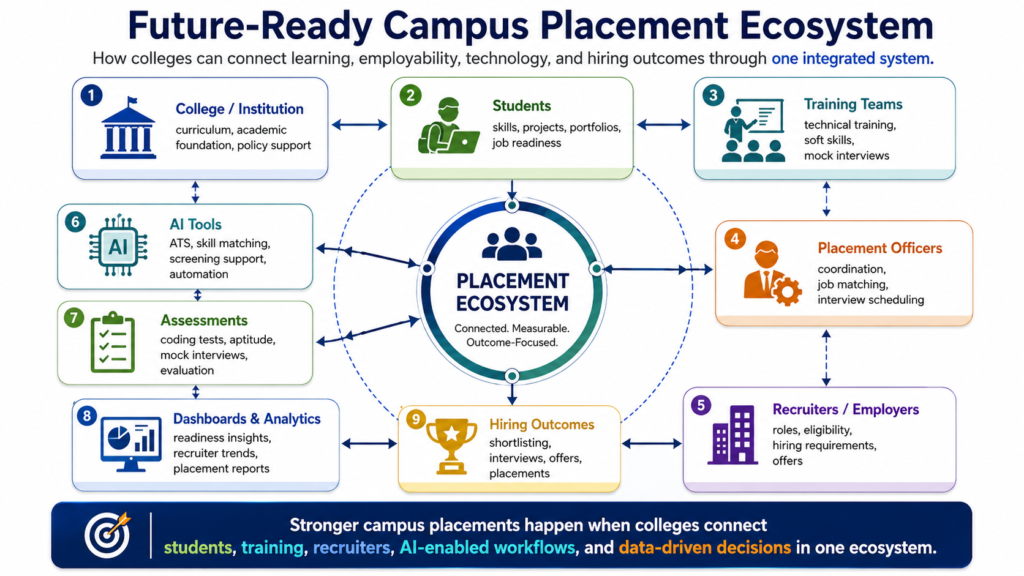
Empower your institution with a Placement Operating System that connects students, placement teams, training teams, and recruiters through one intelligent platform.
From skill tracking and assessments to recruiter engagement and placement analytics, the right technology can help colleges create a more organized, measurable, and skills-focused approach to student employability.
The objective is simple: help more students become genuinely job-ready and help institutions build stronger connections with employers.
An LMS is an important part of modern education, but it was not designed to manage the entire placement lifecycle.
A placement operating system for colleges fills the gap between learning and employment by bringing student skills, training, recruiters, interviews, placement workflows, and analytics together.
As employers increasingly focus on practical skills and job readiness, colleges need a more connected approach to campus recruitment. Instead of managing placements through spreadsheets and disconnected tools, institutions can use centralized technology to understand student readiness, automate repetitive tasks, strengthen employer relationships, and make data-driven decisions.
In 2026, the question is no longer whether colleges need technology for learning. The bigger question is whether they have the right technology to turn learning into career outcomes.