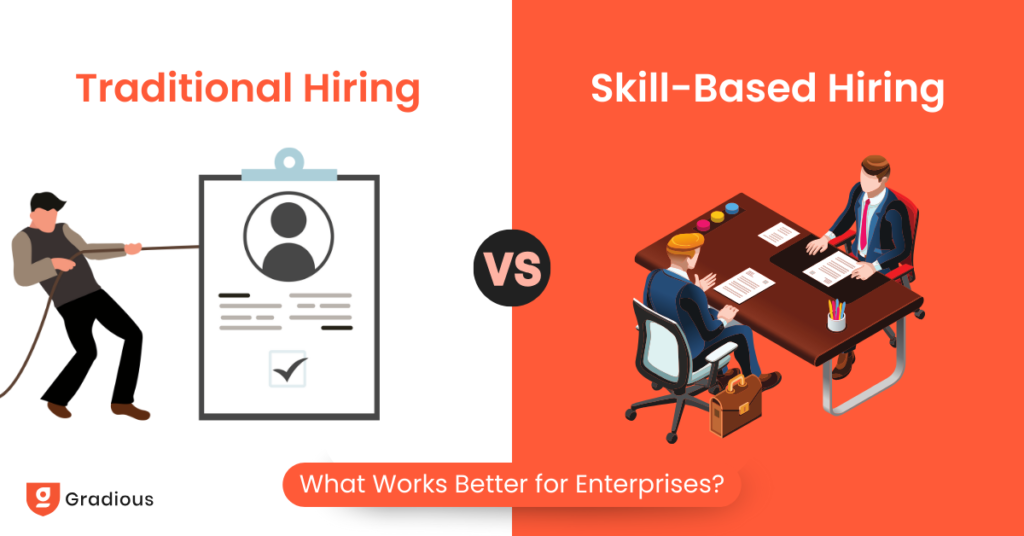
Skill-Based Hiring for Enterprises is reshaping how organizations build, scale, and sustain high-performing teams. For decades, enterprises relied on traditional hiring models that emphasized degrees, resumes, and years of experience. While this approach worked in relatively stable job markets, it is increasingly ineffective in today’s technology-driven and rapidly evolving business landscape.
Enterprises now face pressure to hire faster, reduce workforce risk, and ensure employees deliver value from day one. With continuous advancements in software engineering, Enterprise AI, cloud platforms, data engineering, and intelligent automation, job roles evolve faster than academic curricula or static experience benchmarks.
This shift has accelerated the move from credential-based hiring to skill-based hiring supported by corporate training and workforce upskilling. In this blog, we compare traditional hiring vs skill-based hiring, explain why enterprises are adopting training-led talent strategies, and outline which approach delivers stronger long-term business outcomes.
Traditional hiring is the most commonly used recruitment approach across enterprises. It evaluates candidates primarily on educational qualifications, resumes, job titles, and previous work experience.
In traditional hiring:
While familiar, this approach does not reliably predict on-the-job performance—particularly in technical, AI-driven, or rapidly evolving digital roles.
Traditional hiring often leads to:
Even after hiring, enterprises frequently invest significant time and resources in onboarding before employees reach expected productivity, increasing total cost of hiring.
Skill-based hiring evaluates candidates based on verified, job-relevant skills rather than formal credentials alone. The focus shifts from what candidates claim on paper to what they can demonstrably perform.
In skill-based hiring:
This approach improves alignment between role expectations and employee capability.
Skill-based hiring prioritizes:
For enterprises adopting AI in business operations or intelligent automation, this model offers greater predictability and measurable outcomes.
| Factor | Traditional Hiring | Skill-Based Hiring |
| Hiring Speed | Slow, multi-stage | Faster, assessment-driven |
| Risk | Higher mismatch risk | Lower performance risk |
| Productivity | Longer ramp-up time | Faster job readiness |
| Cost | Higher long-term costs | Optimized hiring ROI |
| Talent Pool | Credential-limited | Broader, skill-diverse |
Skill-based hiring reduces time-to-hire by emphasizing role-specific assessments and skill validation over resume-heavy screening processes.
Traditional hiring often results in mismatches that increase attrition and re-hiring costs. Skill-based hiring lowers this risk by aligning candidate capability with job requirements upfront.
Employees hired through skill-based, training-supported models typically reach effective productivity faster due to structured preparation and applied learning.
The shift toward software skill training B2B reflects broader changes in enterprise workforce requirements.
Technologies such as Enterprise AI, cloud infrastructure, cybersecurity, and data analytics evolve rapidly. Traditional education models struggle to keep pace, leading to:
Enterprises increasingly prioritize predictable outcomes. Skill-based hiring supported by structured training enables:
Software skill training B2B enables organizations to:
Online corporate training for software teams is now a core component of modern enterprise talent strategies.
Online training supports:
Digital training platforms allow enterprises to:
Structured online programs help teams adapt more quickly to:
Corporate technical training programs form the foundation of effective skill-based hiring strategies.
Enterprises benefit from:
Effective programs focus on:
Hands-on project experience ensures:
IT certification training for employees plays an important role in standardizing and validating skills across enterprise teams.
Certifications provide:
Certified employees help enterprises:
A coding bootcamp for existing professionals enables enterprises to upskill current teams rather than replace them.
Bootcamps support:
Employees can:
Bootcamps emphasize:
For modern enterprises, skill-based hiring consistently outperforms traditional hiring across key operational dimensions.
Reduced ramp-up time and improved early productivity allow enterprises to realize value sooner.
Employees hired and developed through training-led models typically demonstrate:
Skill-based hiring is particularly effective for:
Traditional hiring alone is no longer sufficient for enterprises navigating rapid technological and operational change. Skill-Based Hiring for Enterprises, supported by structured corporate training and workforce upskilling, delivers faster hiring, lower risk, and stronger business outcomes.
By integrating software skill training B2B, online corporate training for software teams, and certification-backed learning, enterprises can build future-ready teams aligned with real-world business and AI capabilities.
Ready to Shift to Skill-Based Hiring?
Partner with Gradious to build enterprise-ready teams through training-led hiring and workforce upskilling.
👉 Connect with our corporate training experts today
Skill-based hiring for enterprises evaluates candidates based on verified, job-relevant skills rather than degrees or experience alone.
It reduces hiring risk, improves productivity, shortens onboarding time, and aligns talent with real business needs.
Yes. Through corporate training, bootcamps, and certifications, enterprises can upskill existing teams effectively.
They provide structured learning paths, hands-on projects, and standardized skill validation aligned with enterprise roles.
Gradious delivers industry-aligned corporate training, job-ready skill programs, and training-led hiring models designed for sustainable enterprise growth.
