
Upskilling vs Hiring: Today’s IT companies face a new kind of pressure not from competition, but from capability gaps within their workforce. As AI, Cloud, and DevOps become core to every project, the widening skills gap directly impacts delivery timelines, innovation, and client satisfaction.
For IT leaders, the question often boils down to upskilling vs hiring. Should they onboard new talent at a premium cost, or invest in developing their existing workforce who already understand their systems, clients, and culture through industry-ready training programs
Hiring may offer quick availability, but true productivity often takes time and comes with higher turnover. Upskilling, on the other hand, accelerates workforce effectiveness, boosts retention, and builds lasting technical depth within teams.With structured, data-driven learning powered by platforms like Gradious Leap LMS, IT leaders can transform their existing workforce into highly skilled, project-ready teams — improving productivity and retention at scale.
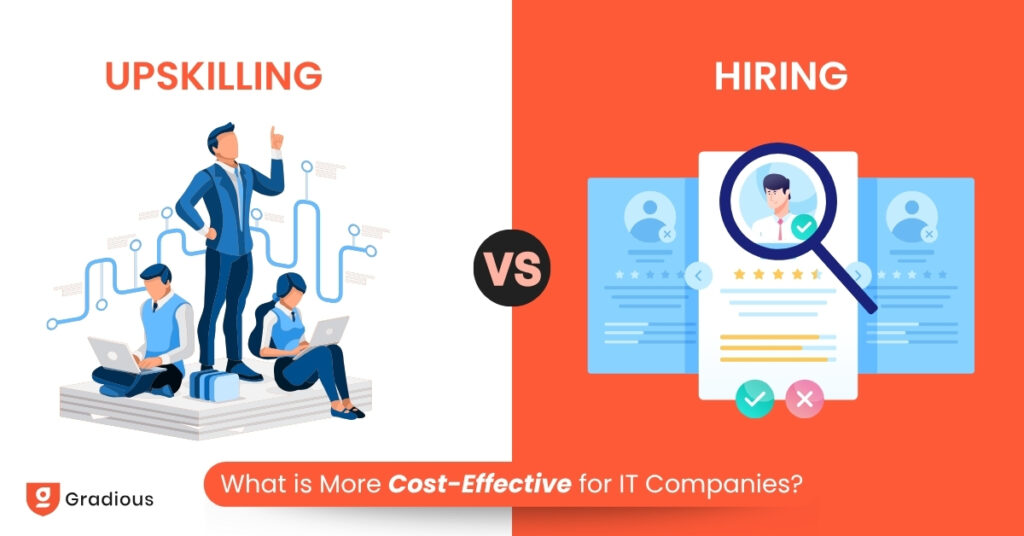
When IT leaders aim to scale or adopt emerging technologies, the default reaction is often to hire. But as project complexity and deadlines tighten, many are realizing that hiring alone can’t sustain competitiveness. Understanding the trade-offs between upskilling and hiring is key to making strategic decisions.
Hiring has long been the go-to method to fill skill gaps. On paper, it seems straightforward — recruit, onboard, and deploy. In reality, new hires often take three to six months to become fully productive, accumulating hidden costs such as recruiter fees, onboarding time, and team ramp-up efforts.
Attrition risk worsens the challenge. If new hires leave within a year due to mismatched expectations, ROI drops significantly.
For example, a mid-sized IT firm expanding its DevOps team may hire external engineers, but six months later, half the team is still adapting to internal processes. The result: capacity increases, but capability lags.
Hiring solves immediate shortages but rarely builds sustainable technical depth.
Upskilling takes a proactive approach — developing existing employees who already align with company systems and culture. Through structured training, organizations can tie learning outcomes directly to project needs.
The benefits are clear:
Gradious Leap LMS strengthens this process by tracking every learner’s journey — from assignment completion and grading to automated evaluation, proctored assessments, and AI-driven interviews. This ensures every learner grows at the right pace while leaders gain real-time visibility into team readiness.
Although hiring might seem like a quick solution in the upskilling vs hiring debate, its hidden costs often outweigh its benefits. Upskilling, on the other hand, compounds internal expertise with measurable ROI through corporate IT training solutions.
Hiring:
Beyond salaries, organizations absorb recruiter fees, interview cycles, background checks, onboarding, and ramp-up time. Replacing an IT expert can cost 4–6x their annual salary, not including project delays or team disruptions.
Upskilling:
Training existing employees is significantly cheaper and faster. With Gradious Leap, organizations can automate performance tracking, run periodic assessments, and measure progress across cohorts — ensuring skill readiness aligns with project goals.
Internal learning initiatives can improve productivity by 25–40% and reduce attrition by up to 50%, making upskilling a high-return strategy for IT organizations.
Upskilling is no longer just a training initiative; it’s a strategic driver of business growth. As technology evolves, companies with continuous learning cultures stay more agile, competitive, and future-ready.
A continuous learning culture encourages curiosity and adaptability. Employees who are regularly upskilled can transition smoothly to new technologies or frameworks — boosting both innovation and delivery speed.
Benefits include:
Gradious Leap LMS supports this by enabling:
Together, they ensure learning outcomes are consistent, measurable, and business-aligned.
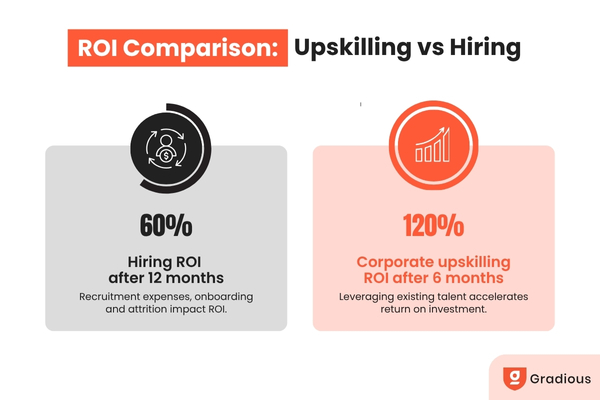
When it comes to ROI, the numbers speak clearly.
Using Gradious Leap’s analytics dashboard, companies can track skill improvement, performance insights, and project readiness in real time — converting learning data into actionable business intelligence.
While upskilling offers long-term value, strategic hiring remains essential in certain cases — such as adopting emerging technologies like AI Agents, Quantum Computing, or Edge Analytics, or when internal teams are at full capacity.
Most IT leaders today adopt a hybrid strategy — leveraging Gradious-led upskilling to strengthen core teams while hiring selectively for niche roles. This balance ensures agility, cost optimization, and sustainable competence.
At Gradious, we help IT enterprises close skill gaps and drive measurable business results through customized, scalable training powered by Gradious Leap LMS.
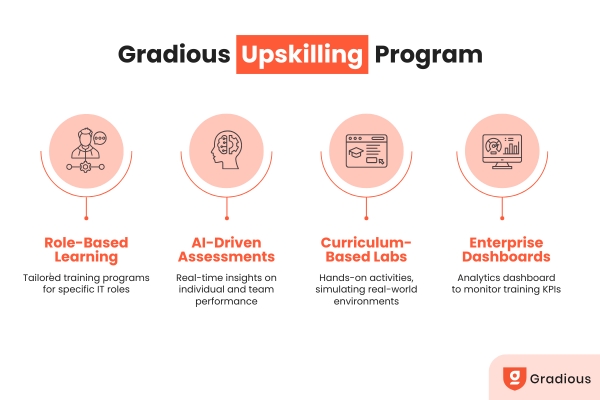
Here’s how:
By partnering with Gradious, IT companies can cut hiring costs by up to 70%, boost retention, and build future-ready teams that drive innovation.
In the end, upskilling isn’t just more cost-effective — it’s more sustainable. Hiring may fix short-term gaps, but it often leads to long-term inefficiencies. Upskilling builds internal strength, improves project quality, and delivers tangible ROI.
With Gradious Leap LMS, IT leaders can directly link learning to performance outcomes — tracking progress, automating feedback, and empowering employees to grow faster.
Start your workforce transformation journey with Gradious today — and turn learning into your competitive advantage.
📞 Talk to our team about building your internal upskilling program with Gradious Leap.”